By Pamela Walsh
In the last article, we learned how a bear, a war-scarred WWI vet and his son were brought together in a sequence of events which led to a very magical series of stories that many children have had as part of the fabric of their childhood.
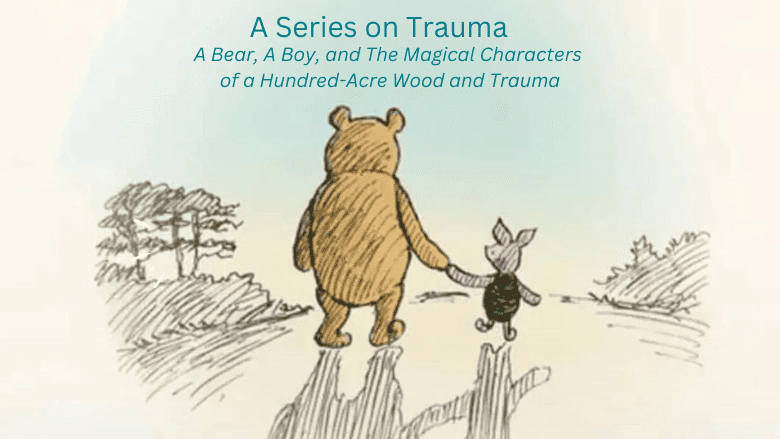
While the characters might be magical creations, some of what Milne writes is inspired by actual places of things. The Hundred-Acre Wood was based on Ashdown Forest, in East Sussex, England, a weekend getaway for the Milnes. Winnie the Pooh (AKA silly old bear, and originally Edward Bear), Piglet, Eeyore, Kanga and Roo, along with Tigger, were from the stuffed animals that Christopher Robin played with. Owl and Rabbit were born for Milne’s imagination. The original drawings of Pooh by E.H. Shepard are not of Christopher Robin’s bear but instead are based on Shepard’s son’s stuffed bear, “Growler.”
Trauma leaves scars: physical, emotional, psychological and spiritual. The reaction to trauma is individual, even when people experience the same trauma simultaneously. While it has never been proven that Milne’s reaction to buzzing bees and popping balloons referred to in the last article was related to his war years, it isn’t that hard to imagine why he would dive for cover, thinking they were blazing bullets or the sound of firing guns. For anyone who has been shot or heard the rapid fire of a gun, you may react in much the same way. Understandably, young Christopher Robin was terrified and confused when his dad reacted in such a frightening way. When we look at the adventures of Pooh with the buzzing bees and popping balloons, they explain in a child-friendly way what Milne was going through.
In much the same way as Winnie the Pooh guides Christopher Robin through the Hundred-Acre Wood, but more importantly, through his childhood experiences, Milne brings to life clues and reactions to trauma that a child may understand in a non-threatening manner. Winnie the Pooh and his friends have much to teach us about anxiety, depression, hypervigilance, irritability, dissociation, and hyperactivity. Even the description of his forever hypervigilant nervous best friend Piglet, the eternally energetic Tigger, rigid Rabbit, forgetful pompous Owl, overprotective Roo and the ever gloomy, hard-on-himself Eeyore show us some common effects of trauma. Let’s look at each of these lovable characters as they take us on numerous adventures and look into the area of trauma to see what they might be hiding.
The happy, somewhat naïve, yet humble Pooh, whom his friends call “A bear of very little brain,” acts with integrity and kindness. He is often inattentive and, when not looking for his favourite snack of ‘Hunny,” is not focused and often is somewhat scattered. These symptoms don’t point us toward Post Traumatic Stress Disorder (PTSD). When we look, however, at Pooh’s general characteristics, he might suffer from an eating disorder, ADD, or disassociation which occurs when the mind leaves the traumatic situation when the body can’t. There is an argument to be made that perhaps either Christopher Robin or Winnie the Pooh do this as a way to cope with difficulties in life.
Piglet, Pooh’s best friend after Christopher Robin, is described as forever hypervigilant and nervous. He always seems on edge. One can correctly describe Piglet as having anxiety and constantly worrying that something will happen. Yet, in trauma, this nearly constant state of thinking danger is ever present are hallmarks of PTSD. With traumatic events rarely foreseen, the unpredictability catches people off guard resulting in the mind being in turmoil. If he were to be given a diagnosis, it would likely be generalized anxiety disorder or social anxiety.
Eeyore’s illness is likely the most recognizable: depression. Yet he also exhibits many symptoms of PTSD. His trauma is experienced by losing his tail. Then Christopher Robin found it and nailed it on. If he were a real animal losing your tail would cause trauma, and having it nailed back on, certainly would not be a great experience. After having it nailed back on, we hear of Eeyore’s incredible effort and head low; Eeyore said it isn’t much of a tail. He was forever gloomy and did not seek social interaction or enjoy things. The emotional and cognitive aftermath of trauma can leave a person questioning themselves through self-criticism, robbing them of the pleasure and joy of activities and life. It can also leave them feeling shame and in a state of gloom, a desolate place that could move a person into a state of despair.
The ever-energetic Tigger would most likely be diagnosed as having ADHD. He has a racing mind as he bounces around, leading to difficulty concentrating. He is forever moving, which can sometimes result in risky behaviour that is often reckless. For those dealing with trauma, these are symptoms of PTSD as well.
Rabbit is a busy yet ever-impatient character, obsessed with rules, inflexible and irritable. These are not considered endearing qualities. However, when one looks at trauma, it is unpredictable, overwhelming and terrifying with chaos. This shakes the essence of what we are taught about how things should be. Rabbit’s black-and-white thinking might be an attempt to keep his world from turning into a catastrophe. It gives him order and a sense of right and wrong.
Owl gives a glimpse of being aloof and better than others. He is situated high in the tree, dictating to others and often unaware of how his lectures are impacting his friends. With his eyeglasses perched on the end of his nose, he has been described as dyslexic. Although he may have this, his actions demonstrate his difficulty in contact and intimacy with others. He may do this to manage his anxiety and PTSD and hide his loss of playfulness.
Kanga and Roo show us both the life of a single parent and a child growing up with just one parent. Kanga is overprotective of little Roo. Yet Roo is out of control and pushes boundaries, yet Roo only sometimes has food. They are sharing the struggles of many people who live in desperation.
Imagination is a powerful tool that many young minds use to shape play, allowing for context in their world. The vivid drawings of Shepard combined with Milne’s creative writing ability are very relatable for children and power many children’s imaginations. In non-threatening ways, these stories did not threaten them but might have helped them identify some areas they struggled with yet didn’t know how to explain.
We will explore how Pooh and his friends continue to empower children’s imagination, giving us wonderfully relevant sayings and how generations still enjoy the magical woods 99 years later with the final article.