Dear brothers and sisters in Christ,
Lenten greetings to each and all of you. We are now entering the second half of the Lenten Season, and preparing to celebrate Solidarity Sunday, a time to give special attention to the Lenten call for almsgiving and reaching out to those in need.
Lent also invites us to consider the ways we are being called to repentance. This examination of conscience should happen not only as individuals but also as communities on local and international levels. God is always faithful and loving; human beings can use their freedom to harm the earth and hurt each other. In this period of reflection, we are invited to open our eyes to the stark contrast that divides the people of God in our own communities and in other parts of the world. Some have healthy living and working conditions, while others are cruelly denied basic human rights by powerful structures of sin. Some have access to participation in governance, thereby affecting policy decisions that play out in their own lives, their families, and their communities, while others are seemingly shut out of all public knowledge and kept in places of darkness. Finally, if wronged, some can access justice while others lack even basic legal rights.
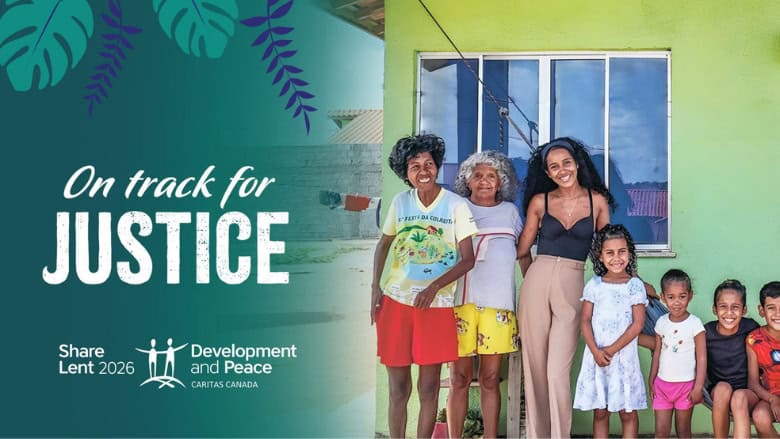
Through Share Lent, Development and Peace – Caritas Canada, offers the chance to stand in Solidarity with countless of our sisters and brothers working for justice around the world. The theme of this year’s campaign, On Track for Justice, follows the story of several Brazilian communities seriously affected by a 900 km mining railroad which connects an immense iron oxide mine in the Serra Norte Mining Complex in the Amazon rainforest with the port city of São Luís in Maranhão. Every day, trains nearly four kilometres long pass by the communities along the railroad, impeding movement, damaging houses by vibrations, and spilling toxic dust from uncovered rail carts. This dust affects the local people’s health, their daily life, and the local environment, like vegetation and water.
Thanks to your generous support through Development and Peace, and the efforts of its partner organization “Justicia Nos Trilhos” (Justice On The Rails), the communities along the railroad have come together to demand justice. The most affected community, Piquiá de Baixo, has been safely relocated away from the majority of the adverse effects. For other communities, the fight for justice is ongoing. As in many other places around the world, the poor are being asked to pay the price, while corporations make a profit.
Our Holy Father Pope Leo XIV, in his Apostolic Exhortation, Dilexi Te, reminds us that “By her very nature the Church is in solidarity with the poor, the excluded, the marginalized and all those considered the outcast of society. The poor are at the heart of the Church” (111). Placing the poor at the heart of our churches means calling to mind the reality that Christ’s poverty “was a radical poverty, grounded in his mission to reveal fully God’s love for us” (18). This is the basis of all Christian outreach, which in large and small acts of love “works miracles and knows no limits” (120).
Let us work for justice in our communities, both locally, and on a global scale. Let us love people, not money, and use resources to build up the common good. I urge you to support the Share Lent 2026 Campaign in your parishes and communities. By showing our solidarity in this manner, we can work together to improve the lives of people all over the world and strengthen the love that holds the Body of Christ together.
Lettre d’appui Carême de partage 2026
To support Share Lent 2026, go to devp.org/give or drop off marked envelopes at your local parish.