(Stock Photo – Canva)
By Dan Sherven
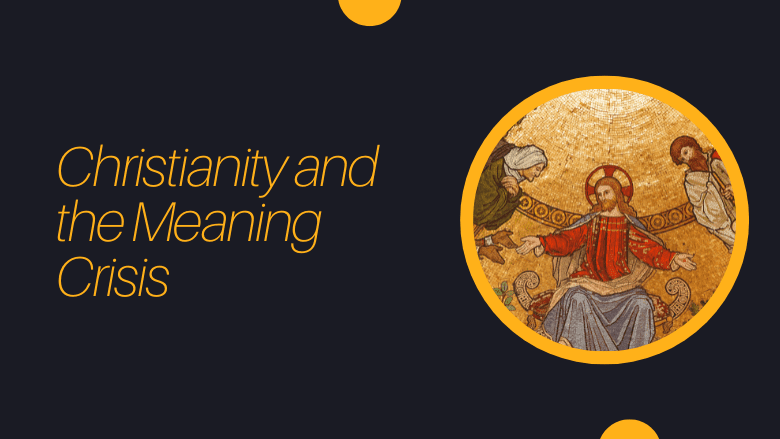
Bishop Maximus of Pelagonia, from the Holy Synod of the Genuine Orthodox Christians of Greece, recently spoke about Christian approaches to the meaning crisis — a phrase popularized by the University of Toronto cognitive scientist John Vervaeke.
Bishop Maximus is the Superior of the Hermitage of St. Ignatius, an Orthodox monastery on a mountain in Guatemala. He does missionary work in Africa and Latin America; and teaches at St. Photios Orthodox Theological Seminary in California.
Maximus says, “The meaning crisis fundamentally is the fact that in our modern society because there is no longer a firmly held belief in — ultimately in reality — but perhaps before that a firmly held belief in various elements of reality, it means that people don’t know what to believe; don’t have firm, fixed beliefs; and therefore don’t know what they are doing with their lives.
“They don’t know what the purpose of their lives is. They become confused. They wander from one thing to another. They seek out temporary and insufficient or provisional solutions to the problem. Basically, anything that will fill the gap; fills the hole that’s inside their hearts. Because they don’t know why they are here in this world, in this existence, and what they’re supposed to do with [existence].
“So fundamentally, it is the result of skepticism and relativism which have been increasing since the end of the Middle Ages up to our present time, in which the skepticism and relativism has developed to something like its ultimate point in post-modernism.”
Skepticism is the philosophical view that all knowledge or some types of knowledge are not knowable. Relativism is the view that truth, morals, and even reason vary from culture to culture, and there are no objective criteria for any of those categories.
Post-modernism is a popular philosophy combining skepticism and relativism to say that arbitrary power is the basis of all human relationships and endeavours because everything is subjective. Without objective truth, there are only competing subjective wills. That holds for both individuals and groups.
As Maximus notes: “Since everything is relative, since there are no absolutes, since we live in a purposeless universe, and since we are just elements; non-special elements within this purposeless universe, there’s no real meaning in life — according to this popular idea which is let’s say the dominant idea within Western culture — people can create their own meaning for their own lives, whatever floats their boat.
“But the problem is that doesn’t actually work. In order for there to be real meaning, there has to be a real connection to reality. Which means first of all, believing that reality exists, that we exist, and moreover, there is a basis behind all reality. Of course, we as Christians would say that is God. God who created all things as an expression of his love, and he created us human beings to inhabit this world and to use this world in order to ascend up to God, to become closer to God, and ultimately for union with God. So this is the ultimate purpose of life, or we could say the meaning for life for us as Christians.”
Maximus continues: “What has happened is that because people no longer believe in an ultimate purpose of life or that there is an absolute foundation behind reality and behind life — because people have lost faith in other words, not just faith in God often but even faith in elements of reality — all sorts of problems have arisen from this: psychological problems, depression, we find people taking all sorts of pills in order to calm themselves down, we see people getting into harder drugs because they’re looking for something more; some sort of experience.”
With that said, cognitive scientist John Vervaeke insists on four types of knowledge that can bring more meaning to one’s life. Propositional knowledge refers to statements of fact, such as scientific works. Procedural knowledge refers to automated processes such as riding a bike. Perspectival knowledge points one toward an awareness of something, such as saying that no language can adequately describe God. And participatory knowledge is the experience one has playing a sport as opposed to watching that sport.
Maximus notes how Christianity incorporates all of these types of knowledge, which are useful in awakening from the meaning crisis. For propositional, there is dogma and theology. For procedural, there is music, iconography, and liturgy. For the perspectival, there are the writings of the fathers. And in the participatory, there is parish life and advancement in grace.
Maximus says that to the extent people use these different kinds of knowledge, “they will increase their meaning in their lives. To the extent that they reject [these types of knowledge], they will find themselves floating adrift and without meaning; without purpose; and falling into these problematic behaviors and thought patterns, which end up with the collapse of the human psyche and ultimately the collapse of a well-structured society.”
Watch the full interview with Bishop Maximus.
Dan Sherven is the author of three books: Light and Dark, the #1 Amazon Bestseller Classified: Off the Beat ‘N Path and Live to the Point of Tears. He holds a Bachelors of Philosophy and a Bachelors of Journalism. Sherven currently writes for Word on Fire, The Symbolic World, the Homiletic and Pastoral Review, Luther College, and the Archdiocese of Regina. Here, you can find his work.