September 13-20, 2020 will see a gathering of the faithful from around the world at the 52nd International Eucharistic Congress in Budapest, Hungary. In preparation for this faith-filled congress, Archdiocese of Regina News Contributor Holly Gustafson leads us in a monthly series of reflections on the Saints and the Eucharist.
By Holly Gustafson
In order to tell you the story of my return to the Church, you have to know the story of my journey away.
It happened in little, tiny rebellious steps, and then one giant leap from God. In my early adolescence, for no other reason than stubborn laziness, I started refusing to get out of bed when my mom tried to wake me for Mass on Sunday morning. I became noticeably and defiantly absent at family pray time. I rolled me eyes at doctrine, and shook my head at tradition. And by the time I was a young adult, peeking out of the teenage years, I’d decided I had absolutely no use for “God.” Nobody was going to tell me what to do; I would make my own destiny, my own choices, not guided by my parents, or faith, or the Church, or, let’s face it, basic morality and common sense.
You can imagine how well that turned out. If the expression had existed back then when I was nearing twenty, by most accounts (including my own), spiritually and emotionally, I was a “hot mess.” I was making some disastrous decisions, not in anyone’s best interests (including my own), and everything was starting to unravel – my academic efforts, my relationship with my parents, my love life, my friendships, my future. So, as a last resort, I turned to the God whom, up to this point, I had felt certain I didn’t need. “Help,” I pleaded to God, hoping He existed, and if so, that He was listening, “I’ve made a mess of everything. Tell me what to do.”
And my dear loving, Father, in His infinite wisdom and in no uncertain terms, spoke directly into my hardened heart and told me, as you might imagine, to quit my nonsense, stop making my childish choices, and return to Him, and everything would be ok. And this is where I’d like to tell you that I obeyed, that I repented of my selfish ways, and that I ran into the merciful arms of my Father, who put everything back in order within me. And I never strayed again. The end.
But, sadly, that’s not how the story goes. Instead, this is where I, upon hearing God’s clear and certain message to mend my ways, did exactly the opposite. If that’s the way God wants me to live, I thought, choosing others over myself and the immediate indulgence of my own wants and whims, I wanted nothing to do with it. I gave God a hard no and walked away. I chose sin and self.
And here’s the thing about choosing sin, and self, over God. It’s very, very lonely. Because sin doesn’t comfort you, and it certainly doesn’t satisfy you, even though that’s exactly what it promises to do. And choosing self over and over again doesn’t gain you any friends, or build relationships, or make you happy, even though you think it will.
I moved away to attend graduate school, where the loneliness followed me, prevailed, and intensified. And somewhere along the way, I met a fellow student, in her final semester, who went to daily Mass. I’d never heard of such a thing (I thought daily Mass was reserved for the pious and retired), but there she was, a totally normal 20-year-old linguistics student, just like me, trotting off to the campus chapel every day at noon between classes on syntax and language death. How strange.
That grad student finished her studies and left at the end of the semester, but the idea of attending daily Mass remained, as persistent and annoying as a popcorn kernel stuck under my gums. But surely daily Mass was not for me. Surely God (if He even existed) wouldn’t want me stepping foot into the campus chapel, when I’d so clearly snubbed Him and marched away. Surely I was neither welcome, nor worthy.
These are exactly the attitudes that St. Pius X was confronted with during his papacy in the early 1900s. A heretical movement called Jansenism had instilled in the Church, over the previous two centuries, the idea that we mere mortals are unworthy of receiving the Eucharist, and that only through rigourous moral standards and severe asceticism could we even dare approach the altar. The movement’s proponents discouraged frequent communion, claiming that the Eucharist should be administered only as a reward to the very pious, and even then, only on solemnities a few times a year.
St. Pius X disagreed. The Eucharist was meant not as a reward for the morally and spiritually perfect, but as a remedy for the weak and failing. “By the frequent or daily reception of the Holy Eucharist,” he wrote in his decree Sacra Tridentina, “union with Christ is strengthened, the spiritual life more abundantly sustained, the soul more richly endowed with virtues, and the pledge of everlasting happiness more securely bestowed on the recipient.” Sure, the Jansenists might have been right that we humans are unworthy to receive the Eucharist, but St. Pius X countered that it was the Eucharist itself that made us worthy; it was “the antidote whereby we may be freed from daily faults and be preserved from mortal sin.”
This is the part of the story where I get to tell you that it’s true. I, feeling lonely and ashamed, unworthy and unwelcome, walked across campus one noon hour and entered the chapel anyway. Lightning didn’t strike me, as I had thought it might, and the holy water didn’t burn as I blessed myself for the first time in many messy years. Nobody rejected me, particularly not God. Instead, I was welcomed by a motley community of clergy, professors, students and staff who had nothing in common but a desire to receive Christ daily in the Eucharist. It was there, at daily Mass, that I received the antidote to my brokenness, and began my journey home.
EUCHARISTIC CHALLENGE OF THE MONTH
Join me in a 12-month challenge to grow closer to the Eucharist this year! This month, make the effort to benefit from the “remedy” that frequent communion provides, by attending Mass more often than you normally do (depending on your life circumstances, this might mean attending one extra daily Mass per month or per week, or trying to receive the Eucharist daily.)
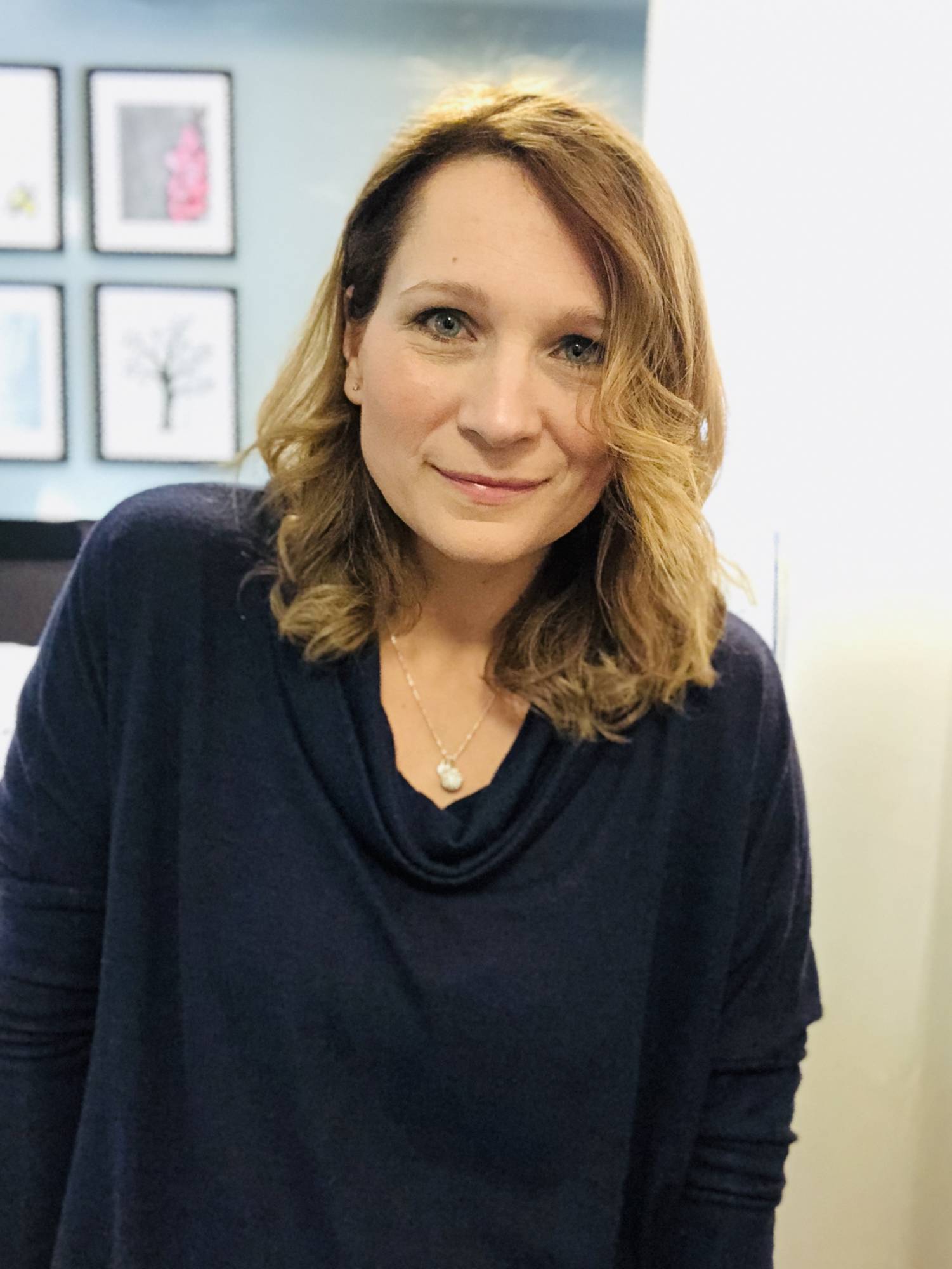 Holly Gustafson lives with her husband, James, and their five children, in Regina, where they attend Christ the King Parish. Holly received her Masters in Linguistics at the University of Manitoba, and now pursues her love of language through art, writing, public speaking, and unsolicited grammatical advice. The best advice she ever received was from her spiritual friend, St. Faustina, who told her that when in doubt, “Always ask Love. It advises best.”