By Dan Sherven
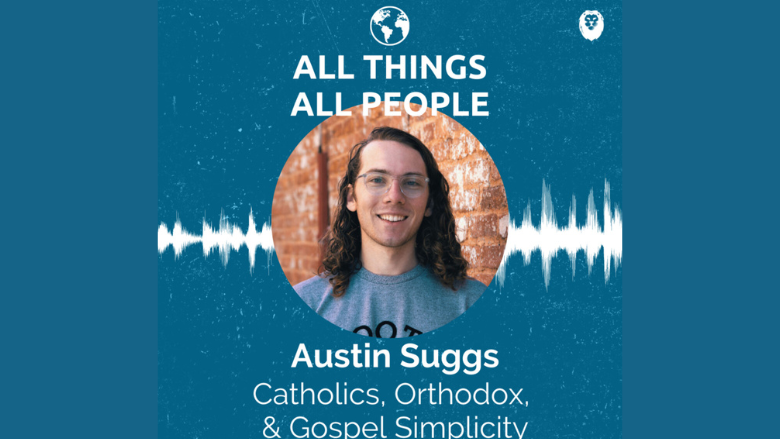
Austin Suggs’ YouTube channel Gospel Simplicity has more than 40,000 subscribers, and has reached over three million people. He is a theology graduate from Moody Bible Institute in Chicago, and is a non-denominational Protestant intent on spreading the Good News. His channel is a podcast which focuses on Christian author interviews.
He says his journey on YouTube began when “the church I was working at made the mistake of letting me teach.” Suggs was working full-time doing an internship with his church between high school and college, while planning to study medicine.
“During that time they allowed me to do some teaching in the high school ministry and I absolutely fell in love with it,” Suggs says. “But I also realized how much I didn’t know which was kind of exciting, but also kind of terrifying.”
“Theology just really appealed to me,” Suggs says. He was drawn to theology not only to get some answers, “but it was also just this amazing puzzle to get to wrestle with these questions that people have been wrestling with for so long.”
After he got the “teaching bug,” Suggs says he was looking for more opportunities to speak. “I was talking to a mentor of mine who was a pastor at another church that I really respected. And I asked him what advice do you have? How can I get better at this? And he said just keep fighting for at-bats. See how many opportunities you can get to speak and do it as often as you can.”
Suggs was already involved with video production at his church. “I’ve got a camera and I’ve got some microphones,” he says. “I could sit down and just start talking to the camera to get better at public speaking and video editing and all that. So at first it became an outlet to get better at communicating all these ideas I had in my head.”
He says having a podcast has its ups and downs. “But on the whole I really enjoy it. At its best I describe it as I get to sit down and have conversations with people I would have dreamed of having conversations with. People whose content I consume just for personal pleasure.
“Not only do I get to have those conversations, not only do I get to make relationships with those people, but I get to share [those conversations] with people and it became part of my job. At that level it’s an absolute blessing.”
Suggs notes, “when you have an audience as diverse as mine they tend to like to argue which can be draining at times. But on the whole, getting to do the interviews — getting to meet people, getting to do the research for [the podcast] — that is all such a great joy.”
His biggest hope for the future of the channel “is that Gospel Simplicity would be a place where people from across the Christian tradition of various viewpoints and various backgrounds, could come together to try to deepen their faith.”
Suggs says that if we see God as truth itself and “we’re all looking honestly, if we’re all trying to search together we should be brought together. At the very least we should be able to understand each other better. That’s kind of the big picture goal for Gospel Simplicity.”
Suggs is also working on a book group for people from Catholic, Protestant, and Orthodox backgrounds. And he’d like to use his theological education plus the connections he has with theologians to provide free educational resources.
He says one series he was teaching with his church heavily influenced his channel. “The series that had the biggest impact on Gospel Simplicity was actually a series on different faiths and different areas of the Christian tradition,” Suggs says.
“I’ve always loved talking with people I disagree with. I find it really interesting. I find it the best way to learn. But I was really scared to misrepresent people. So I told them I would [teach that series] on the condition that I could go and take time to sit down with all of the people that they’d have me represent. So I went and had tea at a mosque, I went and sat down with a rabbi, [and] I went to an Orthodox church.”
“We draw these lines in the sand between us and them, and often we caricature other people. Or we think of them as — ideas are dangerous and we don’t want to interact with those. I was trying to erase those lines in the sand. Not in the sense that we skim over all those differences. Because I do think those differences exist and I think they’re meaningful. But to approach it in such a way that says: I can learn something here. Because if I’m being honest I don’t know that much about a lot of these things.”
Still, Suggs is aware that “increasingly people of my generation are walking out of churches or just never walking in.” He says most of his friends didn’t go to church and “just had no opinion really. It just was a non-issue.”
He says that creates an interesting opportunity: “To not present the Gospel in a fresh way or [with] a new perspective. But just for the first time. And to really present it as Good News. So while there are great challenges in terms of church attendance, and [the] decline of Christianity among young people — I think it creates this opportunity for a New Evangelism.”
Suggs notes that any time the church wanes, the people who are with the church are there because they care about the church. He says he’s witnessing a lot of passion among young Christians, giving him a cautious optimism for the future.
“We live in such a unique time that presents a lot of opportunities,” Suggs says. Illustrating his point with how people might laugh at the dorm room where he started making videos. With the huge mess off-camera and how he was filming interviews in-between his desk and bunk bed. “[It’s] an insane opportunity. I’m still wrapping my head around that.
“The fact that what I’m doing could reach that many people. So there’s the excitement around that. I do think new media has this amazing opportunity to reach masses. But I also think at times that we’ve been a bit overzealous in what it can do. What it’s great at doing is introducing people.”
Yet he says, “I think at times we can be maybe over optimistic about the deep change that results from the internet. And maybe instead of doing — because the internet’s easy, it’s like fast food. You can do it at scale. You can get it cheaply. It tastes good and its fun for a time. But I’m skeptical that at times this can somehow replace the deep work.”
Suggs says “[the internet] can get people maybe to the church or interested in the church. But can we remember — that the core of what we do — I don’t think should ever be increasing the downloads of our podcast or reaching a million people on YouTube. I think Jesus was much more effective with leaning into twelve guys than I’ll ever be in reaching three million views on YouTube.”
For young people who do get interested in Christianity, Suggs says “give it a try. If you’re out there and you’re looking at the church and you’re saying: this is somewhat interesting to me. Maybe I listened to Gospel Simplicity or some far better YouTube channel … This whole Jesus thing, it’s intriguing to me. My biggest thing would be keep taking that next step.”
“Really the best is when you walk through that door,” Suggs says. “You can have this beautiful foyer. But the memories aren’t usually made [near] your front door. The memories are usually made in the living room, around the kitchen table. Where you sit down, you spend that quality time. So if you’re looking at the church and you’re saying this looks pretty, but maybe I’m not feeling that transformation. Or maybe I’m interested but I’m not sure what to do next, just keep taking those next steps.”
“If you really want to experience the heart of Christianity, just keep taking those next steps,” Suggs says. “And have grace for the church, like hopefully it will have grace for you. But give it a try and keep going. I hope that it impacts your life the way that it has mine.”
 | Dan Sherven is the author of three books: Light and Dark, Classified: Off the Beat ‘N Path, and Live to the Point of Tears. Here you can find his books, articles, podcasts, and more: https://linktr.ee/dansherven |