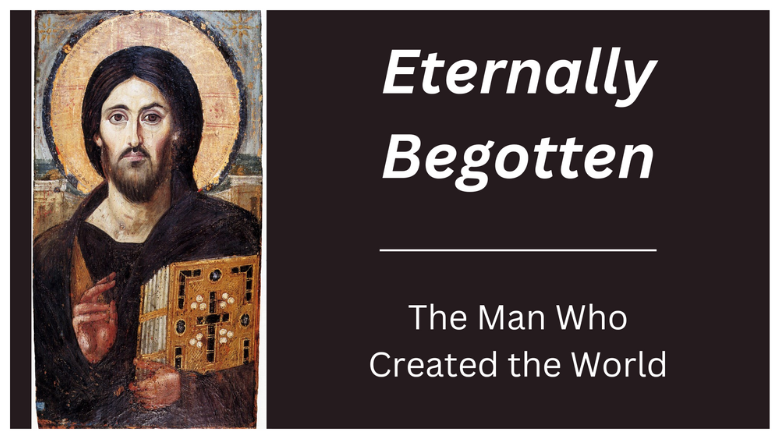
(Photo Wikimedia Commons – Christ Pantocrator” – Saint Catherine’s Monastery, Mount Sinai)
By Dan Sherven
(“Christ Pantocrator” – Saint Catherine’s Monastery, Mount Sinai)
“There was a time when He [the Son] was not,” so Arius of Alexandria, a 4th-century bishop, famously summarized his belief regarding the nature of Jesus Christ; making Christ into a ‘created creature.’ That is the core of the heresy of Arianism, which makes Christ into a kind of demi-god. Making Christ neither fully man nor fully God, when in actuality, He is fully both.
In response to this heresy, the doctrine of the Trinity was upheld as an official Church teaching at the Nicaean Council in 325 AD. The Council was assembled by the emperor Constantine to address the Arian controversy and other broader theological disputes. Even though, as we will see, the doctrine of the Trinity is implicit in the opening of the Gospel of John. It is also true that the Holy Spirit is traditionally spoken of as the love between the Father and the Son, is credited with conceiving Christ in Mary’s womb, and is prevalent (referred to as The Spirit of God) throughout the Old Testament—not least in Genesis, predating the Gospel of John, Arianism, and the official Church teaching on the Trinity.
In response to Arius, the Council gave us the Nicaean Creed, which says that the Son is “eternally begotten” of the Father and states that Christ is “True God from True God,” asserting Christ’s fully divine status.
In understanding all of it: ‘the Logos,’ a Greek word that is often translated as ‘the Word,’ is identified as the Second Person of the Holy Trinity, Jesus. While this borrows from Greek philosophy it remains entirely consistent with Who the Second Person is. The Word is something like ‘creative reason.’ The Word is truthful speech, and the reason that reality is understandable at all. The Word is reason itself and positive creation. Christ, indeed, is all of this.
The Logos (the Word) is eternally begotten by the Father. John’s Gospel states, “In the beginning was the Word, and the Word was with God, and the Word was God” (John 1:1). As such, there has to be an additional faith statement, over and above belief in God and over and above belief in the Trinity, which one makes in accepting the eternally begotten part.
Simultaneous with the Father’s being is the begetting of the Son. The Father begets the Son in a way similar to how a human father begets a son. A human father doesn’t ‘create’ a human son like a man would create a cross or other object. The distinction here would be that while a human father begets a son in time and space with a ‘created’ origin point, that is not what happens with the Father and the Son.
Because the Logos is eternally begotten, it is ‘done’ outside of time and space. The Logos is not “created” but is actually the ‘instrument’ of all subsequent Creation; including time and space itself. “All things were made through Him,” John writes in reference to to the Logos (John 1:3) The Logos is the creative reason of the entire cosmos. In a perfectly Catholic way, one could say that the man Jesus Christ created the world. Some icons indeed show the man Jesus Christ, the Logos, standing outside of the world as the Divine Architect.
In terms of the person of Jesus Christ, because He is fully divine and fully human, the matter of Jesus’ human body is created. However, one would not, therefore, say that Christ is a created creature because He remains the Logos. The Logos is His person, a person fully divine—as in Christ; the Logos is present in a manner that is unlike the way that the Logos is present in any other mortal—although Christ remains fully human. At the same time, mortal humanity can participate in the Logos, but they aren’t the Logos like Christ is.
“The Word became flesh and dwelt among us” (John 1:14). The Word retains His fully divine status while also taking on created matter. So Christ is not a created creature because He is the Logos, God. He retains His status as fully divine, not created, even though He does take on created matter. Making Christ both fully man and fully God.
He fully takes on humanity’s fallen condition, except for sin, to fully save us. Becoming flesh—taking on even created matter—through Mary the Mother of God; conceived by the Holy Spirit but not “created” and certainly not a ‘created creature.’ To say that He is a created creature is wrong, considering that the Father eternally begets (not creates) the Logos at ‘the beginning of time,’ which is actually before time, as time can only be created through the Logos. Arius’ “created creature” idea is wrong as well because it ascribes to Jesus a kind of semi-divine status as if He were not fully human and fully God, but something in-between. In reality, He is both fully human and fully God.
None of this is to downplay the fact that Christ was human. Nor is it to say that the Logos was the ‘real’ Christ and that the material matter, which is His body, is not ‘really’ Him. Christ is fully human and fully God united in one person “without confusion, without change, without division, without separation.” That is the Chalcedon Formula given in 451 AD, as that Council wrote about Christ’s two ‘natures’ being united in one hypostasis, in one person.
Perhaps Arius was trying to make sure that people thought of Christ as fully human because, in the ancient world, it was easier to believe that Christ was God than to believe that God would become man. But in Arius’ formulation the divinity of Christ is not fully expressed. Arius errs too far into Jesus Christ not being God and instead makes Christ a mere created creature. Meanwhile, Saint Athanasius, who at the Council of Nicaea defended the view that Christ was fully God—of the same substance as the Father—later wrote in his work On the Incarnation: “God became man so that man might become God.” Such is the mystery of the Catholic faith.

Dan Sherven is the author of four books, including the number one bestseller Classified: Off the Beat ‘N Path and Uncreated Light. Sherven is also an award-winning journalist, writing for several publications. Find Sherven’s work.