
By Patrick Malone
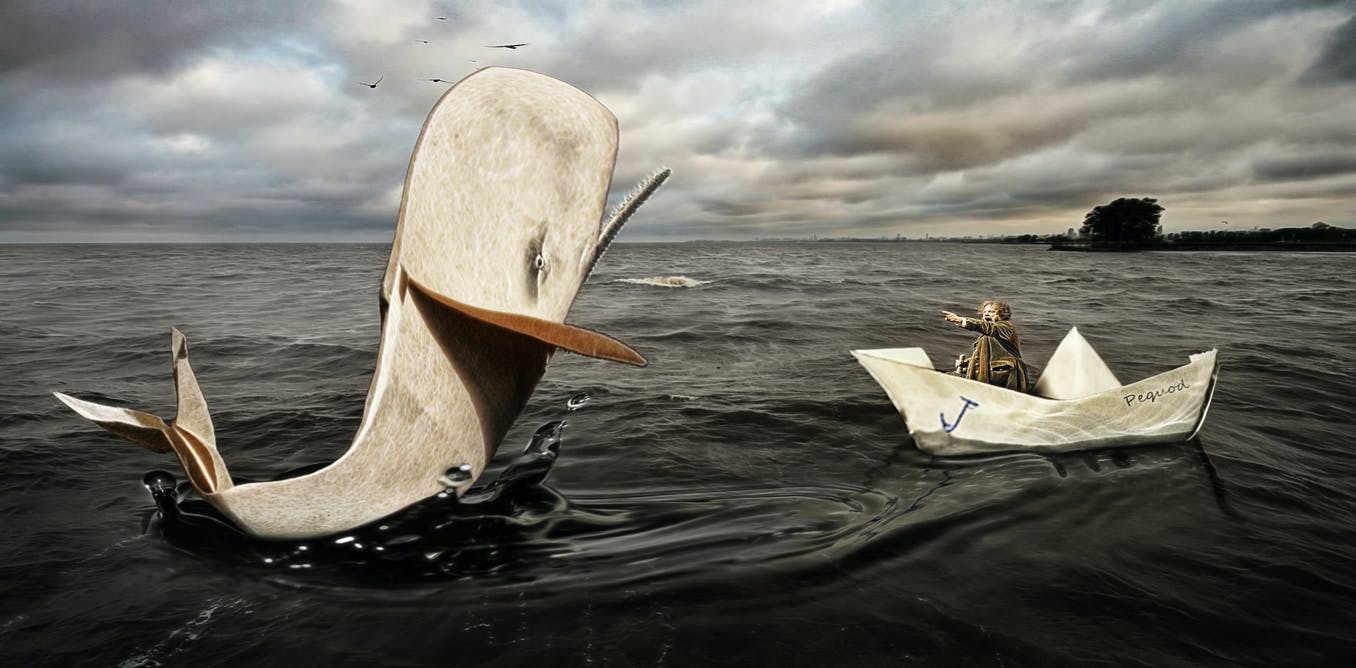
Herman Melville’s novel Moby-Dick may be best known for its depiction of Captain Ahab’s fanatical pursuit of vengeance against the titular whale which confiscated his leg, but it is only slightly less well-known for being a seemingly comprehensive compendium of all whaling science then known to man. While it may be tempting to start skimming where Ishmael the narrator apparently digresses and begins writing a cookbook or a how-to guide for dissecting whales, this preoccupation with technical and scientific achievement actually drives home an essential element of the novel’s exploration of modernity.
To the extent that Moby-Dick’s whalers master the knowledge which Ishmael compiles, they are the masters of nature in that they know where to find whales, how to hunt and kill them, how to process the carcasses, how to survive at sea, and how to profit from this trade. They are not stewards of nature, or just another predator, but Modern Men writ large, who impose their will on the world. They do rely on men they believe to be primitive pagans as harpoonists, but the overarching project is ultimately modern. Modern not in the sense of the present day, but modernity as preoccupied with human technical mastery and dominance over a materialist world.
While vengeance is not uniquely modern, Ahab’s plan to achieve it is quintessentially so. He does not wander the seas looking for the whale, but uses all technology at his disposal to pinpoint where the whale is most likely to be found and engineer particularly lethal harpoons. This is not tradition or folk knowledge passed down through generations, but an expression of human progress.
Ahab pairs this science with diabolism, blasphemously purporting to baptize those harpoons in pagan blood in the name of the Devil. Furthermore, Ishmael associates Moby-Dick’s whiteness with (among many other things) the veil of God, which “shadows forth the heartless voids and immensities of the universe.” The hunt of Moby-Dick by technocratic means is – among other things, but this is my focus today – a challenge to God, a non serviam coupled with a pride in human power. Specifically, it is a challenge to God’s mystery, to the limits of being able to know all of creation, to being dwarfed by the sublimity of the Divine.
Of course, all this knowledge and technological prowess comes to naught. Ahab finds Moby-Dick, but the whale destroys the ship and only the narrator Ishmael survives. For all that information Ishmael set down, they might as well have challenged Moby-Dick with primitive rafts and pebbles.
All of the above is, I think, fairly trite commentary when it comes to Moby-Dick, but it brings me (finally) to my point: the only knowledge left standing at the end of the novel is that of prophecy, while technology and idols have failed; Ishmael is left alive like the friends of Job simply in order to bear witness to total destruction and to tell others of it. Both Ishmael and Job’s friend encounter the mystery of why God permits evil and suffering, and are sent to proclaim something ineffable. Ineffability does not sit well with scientistic encyclopaedias. Neither does it sit well with a portable idol which is not the Logos, the found of wisdom and rationality which roots science. The ineffable Logos may give humans the wisdom and skill to know much of the world, but this knowledge often uncovers yet more mysteries, some of which are solved eventually, but the more we know, the more we discover how little we actually know.
Before setting sail, Ishmael hears a homily preached on the Book of Jonah – the prophet swallowed by a whale, natch – which describes Jonah as trying to flee to the end of the known world, to the limits of human knowledge and power, but floundering when God makes His action known through the storm, and ultimately Jonah must go and prophesy to Ninevah, the great city, urging repentance in the face of their destruction.
Ishmael is saved by a ship named the Rachel which is searching for lost sailors, weeping for her children, as Jeremiah describes Rachel doing for Israel when they have turned to idols and have been exiled. The hubris of thinking that one knows nature well enough to attack and control it for mere revenge, as opposed to stewardship and receiving Creation as a gift, must be repented of before it destroys oneself and others, and like the brothers of rich man who ignores Lazarus, we have the prophets who call us to do that before it is too late.
As Pope Benedict XVI states in his encyclical Spe salvi,
In the nineteenth century, faith in progress was already subject to critique. In the twentieth century, Theodor W. Adorno formulated the problem of faith in progress quite drastically: he said that progress, seen accurately, is progress from the sling to the atom bomb. Now this is certainly an aspect of progress that must not be concealed. To put it another way: the ambiguity of progress becomes evident. Without doubt, it offers new possibilities for good, but it also opens up appalling possibilities for evil—possibilities that formerly did not exist. We have all witnessed the way in which progress, in the wrong hands, can become and has indeed become a terrifying progress in evil. If technical progress is not matched by corresponding progress in man’s ethical formation, in man’s inner growth (cf. Eph 3:16; 2 Cor 4:16), then it is not progress at all, but a threat for man and for the world.
Ishmael recounts wonderful progress in knowledge of nature, but it is not matched by a corresponding response to the prophets which he cites constantly. As a contrary example, one thinks of Dante Alghieri’s virtuosic familiarity with the philosophy and science of his day and his integration of that knowledge into his description of the Christian road to sainthood. Dante’s Divine Comedy presents an utterly rational faith which nonetheless comes up against a wonderful mystery which must be contemplated.
The prophecy which proclaims mystery, which states that God acts in the world, that the world is charged with His sacramental presence, that the world is enchanted with meaning, does not sit well with that modern secular materialism. It is well-established (as Christopher Baglow has recently described) that science is a means of contemplating the mysteries and marvels of Creation, of enabling human stewardship of Creation, but that requires, as Pope Benedict teaches, a progress that relies on discernment, humility, and conversion. This is not a technological crusade against the mystery of God, or an idolatrous flight from the Logos which bestows the wisdom necessary to encounter that mystery and to be masterful stewards of Creation, but a response to the call to repent of either error.
 Malone has a Bachelor of Arts Honours in English from Campion College at the University of Regina, and a Juris Doctor from the University of Saskatchewan. He has written on literature, film, and culture for Catholic Stand and has also been published in Millennial Journal.