
(Photo Credit – Jane Korvemaker)
By Jane Korvemaker
The billowing white smoke from the incense rises and slowly effuses its scent throughout the church like the tide rising along the shore. Kneeling, our eyes are drawn to the altar where sits the ciborium, like a shining golden light on the stone table. This holds the precious body of our Lord, waiting as a lover for us; waiting to enter into the Garden with us alongside him.
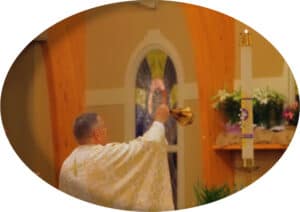
The priest raises himself up, carefully scoops the ciborium, and covers it with the veil he wears. He turns and faces the congregation; the path toward the place of repose for the Eucharistic host is lit with candles. With a slight nod, the solemn procession begins, and we, Jesus’ broken and sinful followers, sing, “Pange, lingua, gloriósi…” Sing, my tongue, the Saviour’s glory.
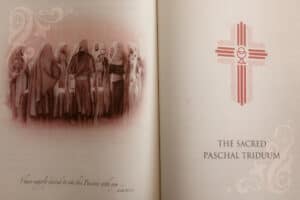
If you attend the Holy Thursday liturgy, this scene will be one of the last images you take with you on this night. One of the beautiful aspects of the Paschal Triduum is that it is one connecting liturgy over the course of three days, like a play with three acts. These liturgies are brimming with the central tenets of our faith, celebrated in worship: the Last Supper, Christ’s death, emptiness, and Christ’s resurrection.
On Holy Thursday, the Triduum begins with the Mass of the Lord‘s Supper, which ends in this somber procession described above. We are invited to keep vigil in the place of repose with Jesus, reminiscent of the disciples in Garden of Gethsemane with Jesus (Matthew 26:36-46, Mark 14:32-42, and Luke 22:39-46). This liturgy has no formal end; there is no final blessing given. Traditionally the vigil is continued throughout the night until the next liturgy begins.
John tells us in his Gospel that Jesus the Messiah, just hours before his arrest, was unceasingly committed to his mission of love and washed his disciples’ feet as an act of humble service. He said to them: “I have given you a model to follow, so that as I have done for you, you should also do” (13:15). In his emptying out of himself in loving service, we find sanctification: “Unless I wash you, you will have no inheritance with me” (13:8).
The Last Supper is a fulfillment of both the Jewish rite of Passover initiated when Moses led God’s people out from Egypt (Exodus 12) and the Law that was given on Sinai (and in particular, the rite of atonement found in Leviticus 16). More than this, it is where Jesus fulfills of the hope of Israel that their God would dwell with them forever (Ezekiel 43). This is the last time we celebrate the Lord’s Supper before the Easter Vigil.
Good Friday continues the liturgy from the previous night; we start kneeling as we found ourselves the previous night. Our vigil with the Lord has ended; we remember the events that led up to his crucifixion in the Liturgy of the Word and adore the cross where our salvation hung. On this day, there is no celebration of the Liturgy of the Eucharist, though we are sustained with Holy Communion, reserved from the celebration the night before.
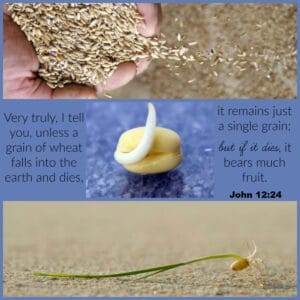
…unless a grain of wheat falls to the ground and dies, it remains just a grain of wheat; but if it dies, it produces much fruit.
John 12:24
There is much material that can provide extensive insight into Christ’s sacrifice on the cross, but this little parable he gives gets to the heart of it. Jesus desires to produce much fruit: the redemption of all creation. This can only be accomplished if that grain is allowed to die and thereby be transformed. We who are baptized have been called to do the same. As St. Paul tells the Corinthians, we are
always carrying about in [our] body the dying of Jesus so that the life of Jesus may also be manifested in our body. We who live are constantly being given up to death for the sake of Jesus so that the life of Jesus may be manifested in our mortal flesh. So death is at work in us, but life in you.
2 Corinthians 4:10-12
On Holy Saturday, there is no major liturgy during the day. What can one say about Holy Saturday, except that it is the epitome of emptiness? The dead do not praise God (Psalm 115:17). We only come together again late at night as we set forth to celebrate the Easter Vigil. Until then, we live in the emptiness and darkness of unknowing. In a paradox that perplexes the mind, it is in this darkness, our darkness, that we can encounter Christ most intimately. Our brokenness can become a unique pathway to be that grain of wheat transformed by his love in death.
The followers of Jesus come together after nightfall to begin the Easter Vigil. The faithful gather and share the light of Christ, the light that “shines in the darkness, and the darkness has not overcome it” (John 1:5). The proclamation of Easter is sung, an ancient song of praise and a call to exult in the wonders that God has done. We are invited to ponder on the golden thread woven throughout the tapestry of salvation history in seven Old Testament readings, and then, the Gloria is sung once again. We enter the New Testament readings and the Gospel of Christ’s resurrection.
In the third movement of this liturgy, having encountered the glory of Christ’s light ablaze in the Easter proclamation and his shining golden thread in salvation history, we joyfully celebrate the baptisms of those entering our church this night and renew our own baptismal vows.
Our altar is now set and prepared for the last movement: our banquet, the liturgy of the Eucharist. After a long hiatus through the memorial of Christ’s passion and death, our community is gathered together in intimate union with our beloved once again, sharing that sacred table at which we feast at the supper of the lamb, “the climax of Initiation and the centre of the whole Christian life” (General Instruction for the Roman Missal, The Easter Vigil, no. 64).
We are joyfully sent forth together with a solemn blessing that exhorts,
Now that the days of the Lord‘s Passion have drawn to a close,
may you who celebrate the gladness of the Paschal Feast
come with Christ‘s help, and exulting in spirit,
to those feasts that are celebrated in eternal joy.
GIRM, The Easter Vigil, no. 68.
You are invited to attend this sacred Paschal Triduum and experience for yourself these moving mysteries. What wonders will God work in you there?

Jane Korvemaker is a B.C. transplant who lives in Saskatoon with her husband, three children, and mischievous cat. She holds a Certificate in Culinary Arts, Bachelor of Theology, Certificate in Youth Ministry Studies, and is a Level Two Catechist in Catechesis of the Good Shepherd. She hopes to one day find the perfect pairing of bacon, beer, and Balthasar. She semi-regularly writes at ajk2.ca