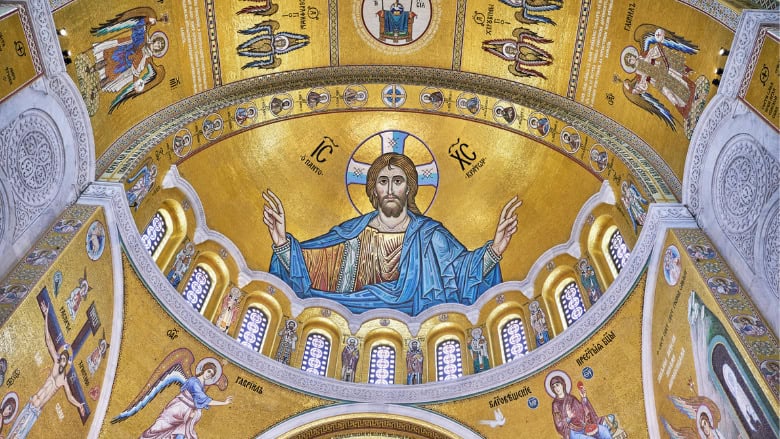
(Stock Photo Canva)
By Dan Sherven
Father Cristian Frunzulica is the parish priest of Saint George Orthodox Cathedral in Regina. He recently spoke about the differences between the Catholic and Orthodox Churches and possible paths toward reunion. The Churches have been officially separated since 1054 AD. Most of the Orthodox population, which is more than 230 million people, is in Eastern Europe. It is the second largest Church in the world.
Vatican II notes that the Orthodox are an apostolic Church, with a true priesthood and true sacraments. Though the Orthodox have different liturgies, church customs, and theological emphases at times, they do not recognize the Pope as the leader of the Church. Still, Vatican II recommends that Catholics draw from the rich Eastern Orthodox tradition.
Two of the biggest differences between the Churches are the role of the Pope and what is known as the ‘filioque.’ The Orthodox Churches prefer that bishops have more authority and that the role of the Pope be less than it is in Catholicism. Although the Orthodox would still recognize the Pope as being “first among equals,” they would like how papal authority is used to be revisited.
Saint Pope John Paul II proposed that there might be another way to look at papal authority, which could help reunite the Orthodox. Removing anything about the papal office which was not absolutely necessary. It wouldn’t mean changing Catholicism; rather, it would be similar to how the Ukrainian Catholic Church has different customs from the Latin Church but remains in full communion with the Pope. There might be ‘rules’ which are not entirely necessary. For example, the Ukrainian Catholic Church does not have to say the ‘filioque.’ Yet, that Church cannot openly deny the filioque (in opposition to the Pope).
Filioque is a Latin word which appears in the Catholic version of the Nicene Creed. That creed is a traditional Christian statement of belief, from 325 AD. The word filioque means ‘and the Son.’ The original Nicene Creed said that “the Holy Spirit proceeds from the Father.” At the time, that version was agreed to by the West (Latin/Catholic) and the East (Greek/Orthodox). Then in the 6th century, the Latin West added the filioque to the Nicene Creed, to highlight the divinity of the Son, against the Arian heresy, which downplayed the divinity of Christ. The filioque was not fully part of the Western liturgy until 1024 AD.
That change was made official by the Pope at the time, and the Eastern churches were not a part of the decision. This led the East to feel that there was a theological issue in giving ‘procession’ to the Father and the Son.’ Plus, the East did not like the Pope making the change without involving the Eastern Church. It became a theological and church governance issue. One which continues to the present day.
“There are attributes,” Father Cristian says. “Divine attributes that apply to the essence of God, and there are divine attributes that apply to the persons of the Holy Trinity. So we say that we believe in one God, in one essence and three persons. Now each person has specific attributes.”
He continues, “These are attributes that refer to the person, not to the essence of the divinity, and they’re unique for each person.” The attributes are not about superiority; the Persons of the Trinity are all equal.
Father Cristian notes that at the first and second councils of Nicaea, it was decided that the “Father is the one who begets the Son and gives procession to the Holy Spirit.” Also, that “the Son is the one who is begotten, [and] the Holy Spirit is the one who proceeds from the Father. But all of them are equal. They have the divine essence. The fullness of divinity. There’s nothing different when it comes to essence — to their equality in terms of being God.”
The Orthodox objection to the filioque, is that it creates an instability in the Trinity. Father Cristian explains: “We have attributes that refer to the persons and attributes that refer to the divine essence. So, the moment you say that the Father and the Son have this common attribute, that they both precede the Holy Spirit, then you kind of make the Holy Spirit inferior to the other two.”
One Catholic view might be to say that the Holy Spirit proceeds from the Father, through the Son. Seeing as the Son is the Word the Father uses to create everything at the beginning of time. Christ also breathes the Holy Spirit onto the apostles. The Holy Spirit proceeds from the Father, though the Son.
Father Cristian notes that some agreement could be reached. “Some Orthodox theologians say that [the filioque is] only a matter of terminology and it’s solvable. We could get to some kind of common formula. But first we have to come together and have a dialogue.” Father Cristian continued to speak about the importance of dialogue as a starting point for a possible reunion between the Churches. Adding that there should be a focus on the common elements which already exist between East and West.
“No doubt there is an apostolic origin in both Churches,” Father Cristian says. “Nobody says that it’s an easy task [to reunite], but yeah, we should try to do it.”
Dan Sherven is the author of four books, including the number-one bestseller Classified: Off the Beat ‘N Path and Uncreated Light. Sherven is also an award-winning journalist, writing for several publications. Find Sherven’s work.