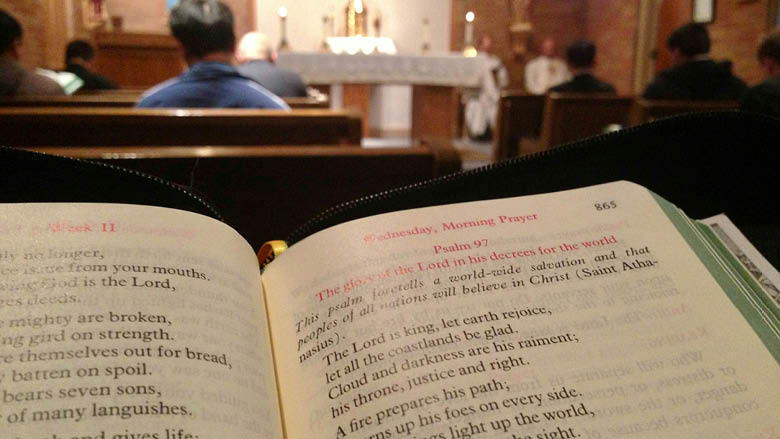
(Stock Photo Unplash)
By Ken Rolheiser
There is a line in Don McLean’s “American Pie” which says, “Can music save your immortal soul?” A better question might be, “Can you save your immortal soul without music?”
I remember the first time a priest sang the Consecration of the Mass. The power of those sacred words expressed artistically in music added something incredible to the emotional impact of the event.
As Wordsworth’s line says, “The music in my heart I bore, long after it was heard no more.” We have all left the church or the theatre with a song in our hearts.
Music is a powerful form of communication because it engages emotional, social, and cognitive areas of the brain. Music helps people connect, express themselves, and understand each other—even without using words.
I can picture myself, a sinner, travelling down the road of life with the Lyrics of John Lang’s song echoing in my heart: [Mr. Mister’s]
“Kyrie eleison, down the road that I must travel / Kyrie eleison, through the darkness of the night.”
The inspiration to continue my life’s journey on the road to perfection is easier with a “Lord have mercy” on my lips. Very similar to the German version of “God be merciful to me a sinner.”
Many of us could sing a psalm right now. It might be “The Lord Is My Shepherd” or a hymn based on one of David’s psalms, like “The heavens proclaim the glory of God, and the firmament proclaims his handiwork.”
Music is man’s oldest language. Ninety percent of the world’s population listens to music. Before man could write, drums and chants and song communicated emotion and meaning.
Before we learned the alphabet, folk tunes, lullabies and songs strengthened our memories and conveyed our emotions of joy, grief, love and vulnerabilities. Music often communicates the inexpressible.
Music bridges cultural and social divides. From spirituality to pop music, a tune will touch the hearts and souls of listeners who speak different languages. A national anthem unifies a whole nation.
Music and worship are natural to us. As children, we inhaled music’s spiritual fragrances. In preparing this column, I recalled a German hymn, “Maria zu Lieben,” which I first sang with my parents and siblings. My brother-in-law’s siblings gathered to sing this hymn as their mother left this world.
The English lyrics include: “To love you, O Mary, is my constant desire… You are my sweet Mother, and I am your child. In this life and in death may I be only yours.”
We catch the sweetness of prayer and devotion in different languages, like Schubert’s Latin “Ave Maria.” Originally a song from the narrative The Lady of the Lake, where a character sings a prayer addressed to Mary. Schubert’s song became so popular that many believe he wrote the melody for the “Ave Marie” prayer.
Pope Leo recently pointed out that in the liturgy, we are always also in invisible communion with all the angels and saints. We are present with those who most recently were with us, singing and worshipping.
At our best liturgical celebrations, like weddings or funerals, we are keenly aware of the nearness of family members and Saints who have gone before us. They are surrounding us in the church and ringing the altar.
This is the true situation at every Mass. Sometimes I think I have heard my late father’s voice as we praise God together with the Saints. Heaven is in the neighbourhood when we gather to sing with the Saints.

Ken Rolheiser is an author of six books and a spiritual column PAUSE FOR REFLECTION since 1998. A lay minister in St Joseph’s Parish and an occasional speaker, Ken has been involved in the Canora Ministerial Association and the Archdiocesan Stewardship Committee (as well as others). For details see www.kenrolheiser.com.