Stock Photo – Canva
By Dan Sherven
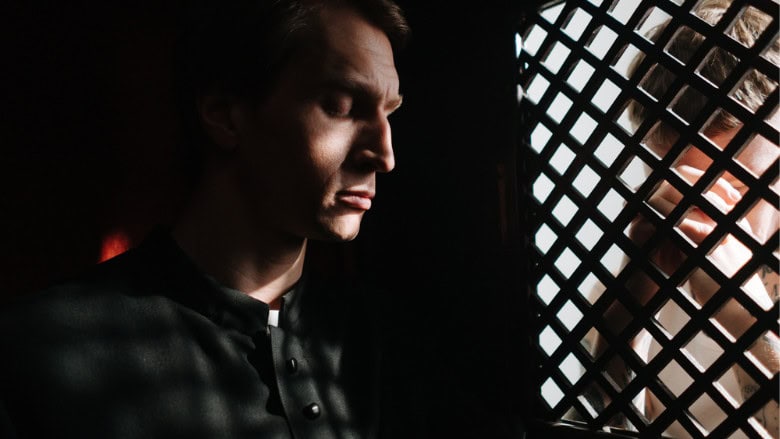
It’s been 17 years since my last confession. For many years I was not part of the Church. As a child I attended Catholic school, both elementary and high school. Then I went to a Jesuit college. And I was reasonably devout as a child. But I don’t think I ever went to confession past my confirmation into the Catholic Church, at about 14 years-old. I am currently 31 years-old.
As the rock group Led Zeppelin’s “Stairway to Heaven” recognizes, “Yes there’s two paths you can go by, but in the long run—and there’s still time to change the road you’re on.” A person is either moving toward a full embrace of God, or toward a rejection of everything True, Good, and Beautiful; as the Catholic writer G.K. Chesterton alluded to. Because Christ forces a decision to either fully embrace Him or reject Him. His existence on earth doesn’t allow for a neutrality. Everything about Him forces a person to either consider Him God or not.
My adolescent rejection of God was based on the reasoning of the philosophers, and it ultimately led me into a agnosticism—choosing not to decide whether God exists. After that I was drawn into the Eastern philosophies—and I still do meditate—particularly the religions of Buddhism and Daoism, which are more about flow and do not have a personal God at all.
But as soon as there is a real crisis, as I found out, everyone believes in a personal God. There are no atheists in fox holes, as the war cliché says. But I did find myself in an actual crisis, as many sinners do—where there is no solution to the problem other than help from a personal God.
I have since gone to therapy, which is our modern solution to a lack of confession. It seems that human beings have a need to confess their sins to another person; whether one is religious or not.
Clinical psychologist Jordan Peterson influenced me more than anyone in the return to my childhood faith. Despite all the Catholic education of my youth, and a philosophy degree, Peterson was the first person I’d ever heard present Christianity as intellectually viable.
Peterson speaks about Moses seeing the glimmer of the burning bush out of the corner of his eye. Elsewhere Peterson notes how “interest manifests itself, and grips you.” Over time, the religious claims that caught my interest increasingly made more sense out of my day-to-day experience than any other system of thought had.
There’s a certain death which one must willingly undertake, if one is going to go to confession. The late Archbishop Fulton Sheen said: “The Greeks came to our Lord. And we do not know what the Greeks asked our Lord. But we can guess it. Because of the answer, of our blessed Lord to the Greeks. I think the Greeks said to our Lord—and this was within two weeks of his crucifixion. “’If you stay here among these people, they’re going to kill you. Why don’t you leave this land? Come to Athens. We’re the country of the wise men. We’ve only killed one great mind in our history. That was Socrates, and we regret it; ever since—that we gave him that poison. So if you stay here you will die. If you come to Athens you will live.’
“Our Lord could not quote—for example, a Prophet to [them]. He could not quote—‘Hey no, it has been prophesized of Me.’ He appealed to nature. Because the Greeks could understand that. He said, ‘Unless the seed falling to the ground dies, it remains alone. But if it dies, it comes forth unto life. And bears fruit in 20 and 100 fold.’ That was a lesson the Greeks could understand.”
Saint John the Evangelist merges the wisdom of ancient Greek philosophers with the Hebrew concept of Yahweh writing, ‘In the beginning was the Logos,’ and ‘The Word became flesh and dwelt among us.’ This idea, however, presents a challenge. As Saint Paul notes, the Logos crucified is a scandal to the Jews and folly to the Gentiles.
I started out in Athens, but found that the Logos of Athens ends where Jerusalem’s begins. Now I ascribe to the Logos of the Catholic Church. Peter is the rock upon which Christ said He would build His Church. The keys to the Kingdom of Heaven were given to Peter. The gates of Hell will not prevail against that rock; and we have certainly seen the Hell. I increasingly agree with all aspects of Catholic thought which I encounter. Not that I’m always able to act accordingly.
But that is what the sacrament of confession is for. To speak with a representative of the Word, about how one has chosen to eat from the Tree of the Knowledge of Good and Evil—thinking one has the ‘knowledge’ needed to decide what good and evil are; ‘knowing’ good and evil— making oneself God, rather than choosing Eternal Life. And confession is a stairway to heaven.
We are created to live in a state of grace, not one of sin. And as we wind on down the road, our shadows taller than our soul. That is essentially the state of mortal sin. There walks a lady we all know [the Mother of God], who shines white light [grace] and wants to show, how everything still turns to gold [“Be still and know that I am God”], and if you listen very hard, the tune will come to you at last [the Truth which Christ is], when all are one and one is all. [The deification of Man; through participation by grace in the Life of the Holy Trinity; bought with Christ’s blood.]
Christ will forgive our sins, if only we are humble enough to seek out that forgiveness through his Church. So perhaps it’s time I fully step into that Church, by going to the sacrament of confession. To enter back into full communion with Rome, the rock, and be able to partake of Eternal Life; through Christ’s body and blood. Because as Christ pointed out, perhaps there is nothing worse than to be lukewarm about God and one’s own soul. To be a rock and not to roll.
Listen to Dan Sherven talk more about his faith journey on Thinking Faith!

Dan Sherven is the author of four books, including the number one bestseller Classified: Off the Beat ‘N Path and Uncreated Light. Sherven is also an award-winning journalist, writing for several publications. Find Sherven’s work.