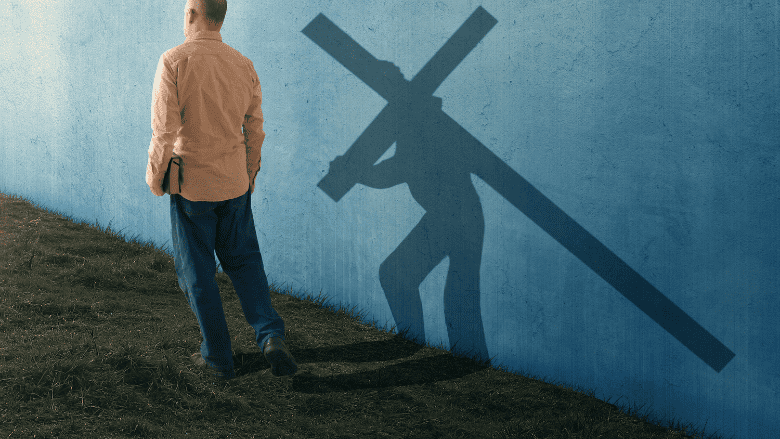
(Stock Photo – Canva)
By Ken Rolheiser
“[Dying] has the most profound purpose and meaning…
“The last breath, the last heartbeat, the wrenching open of the veil that moves our loved one away from pain forever…
“There will never be another moment that compares to this in life … the last kiss, the last embrace, the last conscious moment that you’ll ever share.” (Tarrant-Hoskins).
To witness life’s transformation, the reunion of a soul with its maker is a moment to be cherished and shared. As Christians who hope in God’s promises, we give thanks for a journey completed and a destiny attained. Though the world may seem empty, we let God’s promises shine on our problems.
From the moment of our baptism, we have been marked for Christ. We carry the promise of heaven in our souls. God himself will dance with joy over our salvation. Yahweh has repealed our sentence, which we incurred through Adam (Zephaniah 3:14-17), and has taken away the evil we feared.
Through original sin, suffering and death are a part of the human condition. Carl Rahner says Christ’s death on the cross was to redeem all. As children of Adam, we had sin, but as sons and daughters of God, we have Grace. We must choose between “personal sin” and “faith, hope, and charity.” How we stand before God is determined by our “free choice.”
When Jesus was going toward Jerusalem, he told the disciples about his coming suffering and death. Peter said, “This must not be.” Jesus rebuked him: “Get behind me, Satan” (Matthew 16:23). As Christians, we are asked to “take up the cross” of suffering. We unite our suffering to the Cross of Christ for our salvation and that of the world.
The world tempts us to avoid terminal illness and suffering through euthanasia. That was not the way of Jesus, and it is not the way of his followers. The Church gives us clear direction on this matter: you do not get to choose to end your life unethically. There are moral principles at play.
You do not have to choose to prolong the dying process. You can refuse treatment, feeding tubes, and ventilators. You can refuse resuscitation at some point in your health care. You can appoint a family member to see that your wishes are known when you are in an unconscious state.
Dying is a natural process and can be a positive learning experience for family members. The two greatest fears about dying, pain/suffering and fear of abandonment, can be looked after with appropriate care-giving or palliative care.
The greatest meditation related to pain and suffering is to reflect on the Passion of Jesus. Our Lord said to St Bernard, “I will remit all the venial sins and I will no more think of the mortal sins of those who honour the grievous wound on my right shoulder, which caused me unutterable pain when bearing my heavy cross to Calvary.”
Malcolm Muggeridge says, “This horror of pain is a rather low instinct and… if I think of human beings I’ve known and of my own life, such as it is, I can’t recall any case of pain which didn’t, on the whole, enrich my life.”
Suffering seems to have lost its meaning, Elisabeth Kubler-Ross said, but the Lord has a plan for our suffering. When we see Christ’s image in our suffering, our pain and agony can be united to Christ’s suffering, working to redeem us all.

Ken Rolheiser is an author of six books and a spiritual column PAUSE FOR REFLECTION since 1998. A lay minister in St Joseph’s Parish and an occasional speaker, Ken has been involved in the Canora Ministerial Association and the Archdiocesan Stewardship Committee (as well as others). For details see www.kenrolheiser.com.