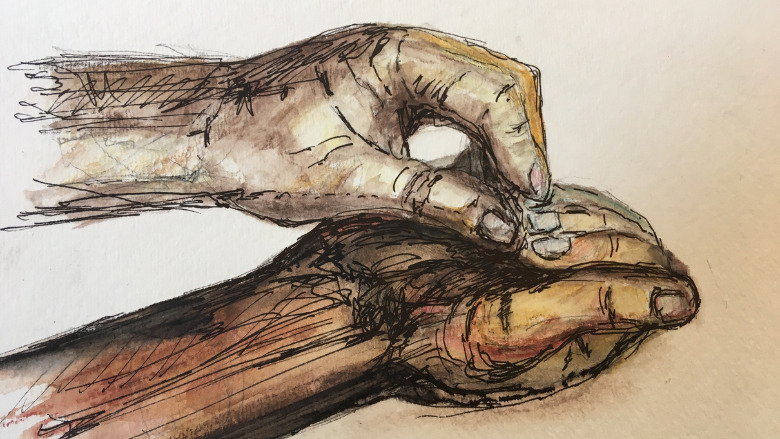
“My Lord and My God” affirms St. Thomas when meeting the Risen Lord — the Paschal Mystery of the death and resurrection of Christ is inherent in “the mission that has a Church.” (Image by artist Diccon Olivier)
By Peter Oliver, Catholic Health Association of Saskatchewan
I’m not a big fan of tattoos but if I were to get a tattoo, this sentence from Michael Downey’s article, Consenting to Kenosis, would be a contender: “It is not so much that the Church has a mission; it is rather more that the mission has a Church.”
I’d have it inscribed over my heart with the words “CATHOLIC HEALTH CARE” in bold above it.
(I’m sure more than one person read that and thought, “For the love of Mike, this guy needs to get a life.” Alright, that was a bit more than quirky; still, it’s a great line and it deserves further exploration.)
Let me begin with a story.
In my early twenties, I worked as a care aide for a man named Glen who suffered from multiple sclerosis. The disease ravaged his body, leaving him wheelchair-bound and, for the most part, alone in what was his childhood home.
The days were long for both of us. His schedule involved me offering care for a couple of hours in the morning, a couple of hours at dinner time, and a couple of hours at night. He was a night owl, so the night shift often ended at around midnight.
As his condition deteriorated, two generous friends of mine agreed to spend their nights at his place to turn him in bed, preventing pressure sores.
While remaining affable, his was a profoundly difficult journey – all his teeth had decayed, he was often constipated or soiled, his speech and vision were impaired, and he spent so many listless hours simply waiting in his wheelchair for my return.
Time passed and I moved to Arnprior, Ontario to enter the novitiate with the Oblates of Mary Immaculate. Before I left, I found a conscientious individual who agreed to assume my role, and I later learned that Glen moved to the Parkridge Care facility, where he died.
One summer I returned to Saskatoon and visited his grave. Etched on his headstone were the words, “Only God understands.”
I can imagine the sadness, sense of futility, and helplessness that may lie behind those words, but they also point to a sobering truth. We stand on the unfinished side of Glen’s grave; “he is consoled in the bosom of grace”
The words on Glen’s headstone are a kind of interstice – a word which describes a small, intervening space between things. In this case, they point to the razor-thin gap where our reality ends and a reality that is beautiful, supra-corporeal, and bursting with life begins.
The scriptures convey this interstitial reality in the recognition expressed in the apostle Thomas’ “My Lord and my God” (John 20:28), the tender moment when Mary hears her name and realizes the person she “supposed to be the gardener” is actually Jesus (John 20:16), the awakening of the disciples on the road to Emmaus as it dawns on them that the person who has been breaking open the scriptures is actually Jesus who was crucified (Luke 24:13-35), and Paul’s ineffable gasp on the road to Damascus, “Who are you, Lord?” (Acts 9:5).
“It is not so much that the Church has a mission; it is rather more that the mission has a Church.” That’s where we started. This is the application.
The mission is not a thing, an ideology or action plan, a set of deliverables or a value proposition, a fortress to be defended or a culture war to be won.
The mission is a living reality—God in the very fibre of our existence, pulsing, living, breathing, forgiving and healing.
The mission is most fully manifest when we participate in God’s kenosis (God’s self-emptying) and most fully realized when God’s “in-breaking” substantiates the plausibility of our conviction – Christ is risen!
The words on Glen’s headstone are an interstice which point to the nature of those claims. Suffering and death are not the last word; the unconditional love of God expressed in God’s identification with those who are most abandoned has the final say.
Lastly, and most importantly, this mission has a Church (of which Catholic health care is an essential part) and this Church is called to incarnate this living-truth in the very marrow of its existence.
Source for quote by Michael Downey: “Consenting to Kenosis: Mission to Secularity” from the book In Secularity and the Gospel: Being Missionaries to Our Children, edited by Ronald Rolheiser, OMI. Crossroad Publishing.