
By Deacon Eric Gurash
On Thursday, March 30 the Vatican officially repudiated what has become known as the ‘Doctrine of Discovery,’ namely, any concept or argumentation used to provide justification for the claiming rights as colonizing powers to land which had been lived on by Indigenous Peoples for thousands of years. “In no uncertain terms, the Church’s magisterium upholds the respect due to every human being,” the statement reads. “The Catholic Church therefore repudiates those concepts that fail to recognize the inherent human rights of indigenous peoples, including what has become known as the legal and political ‘doctrine of discovery.’”
The statement, put out jointly by the Dicastery for Culture and Education and the Dicastery for Promoting Integral Human Development, affirms the inherent rights of Indigenous Peoples and calls for more actions to be taken to improve living conditions, rights, language, and culture.
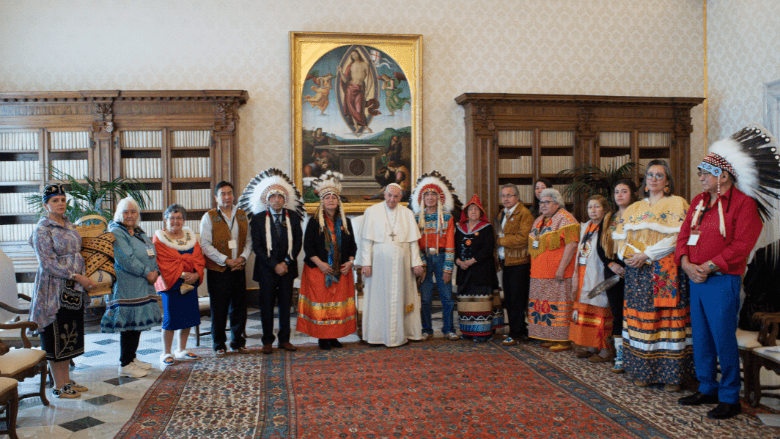
The Canadian Conference of Catholic Bishops (CCCB) issued an accompanying note expressing gratitude for the statement. It noted that Pope Francis had listened to the strong request from Indigenous Peoples, both in the context of their visit to Rome last March, and while during his visit to Canada, to repudiate the doctrine of discovery and to address a series of papal bulls from the 15th century which provide moral legitimacy to the kings of Portugal and Spain in their colonizing enterprises which led to the taking as their own lands which they ‘discovered.’
The statement acknowledged that papal bulls Dum Diversas (1452), Romanus Pontifex (1455), and Inter Caetera (1493) did not adequately reflect the equal dignity and rights of Indigenous Peoples, and that the bulls were manipulated for political purposes by competing colonial powers, contributing to the great suffering experienced by Indigenous Peoples as a result of colonization and colonizing attitudes which have persisted through the centuries. Acknowledging the Church’s failings in this regard, the statement asked pardon of Indigenous Peoples.
The Holy See’s statement also clarified that while the papal bulls had negative consequences for Indigenous Peoples, they were political statements, not doctrinal ones. These bulls have never been considered expressions of the Catholic faith, but rather, had a political aim of helping to maintain peace between Spain and Portugal. It stressed that there is no Catholic ‘doctrine’ of discovery.
The statements from both the dicasteries and the CCCB are clear that much work still needs to be done. The CCCB, the United States Conference of Catholic Bishops (USCCB), and the Pontifical Committee for Historical Sciences are exploring the possibility of organizing an academic symposium with Indigenous and non-Indigenous scholars to deepen the historical understanding of the ‘Doctrine of Discovery.’ The idea has received encouragement from the two Dicasteries that issued the joint statement.
“More recently, the Church’s solidarity with indigenous peoples has given rise to the Holy See’s strong support for the principles contained in the United Nations Declaration on the Rights of Indigenous Peoples. The implementation of those principles would improve the living conditions and help protect the rights of indigenous peoples as well as facilitate their development in a way that respects their identity, language and culture.”
In closing, the CCCB echoed Pope Francis’ statement from July 2022, saying “never again can the Christian community allow itself to be infected by the idea that one culture is superior to others, or that it is legitimate to employ ways of coercing others.”