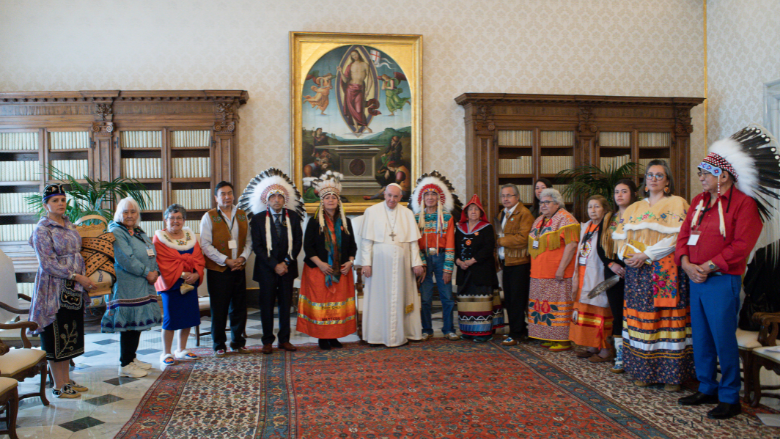
Photo Credit: Indigenous Delegates, including Chief Marie-Anne Day Walker-Peltier, meet with Pope Francis – Courtesy of Vatican Media
Walking Together in Rome “A Very Important Step” – By Dan Sherven
On April 1, delegations of First Nations, Métis and Inuit people met with Pope Francis at the Vatican to speak about the role the Catholic Church had in Canada’s residential school system. “The purpose of the delegation was to take a step toward healing and reconciliation,” said Archbishop Don Bolen, who was one of the bishops accompanying the delegation.
Chief Marie-Anne Daywalker-Pelletier of Okanese First Nation near Balcarres, Sask., was one of the representatives. “To me it was a very spiritual journey,” Daywalker says. “A journey that reflects the ancestors’ hurts and pains. The journey that I went on, I carried those feelings of pain and sorrow and abuse to the Pope, to Rome. To me that reflects the amount of spirituality — and Creator being with us, as we encounter that journey.”
“The goal of the present time is to try to learn a new way to walk together with Indigenous Peoples,” Bolen says. He adds the goal is also to acknowledge the suffering caused by the residential school system, and come to terms with the Church’s involvement in the government’s project of assimilation, including “the suppression of Indigenous language, culture, and spirituality, and the various kinds of abuses that took place in the school system itself.”
Bolen says the goal is to take a real, tangible step toward that process of walking together and “address the request from so many Indigenous people to have Pope Francis engaged in this reconciliation process. So it was a step that was possible prior to his coming here.” The Pope is visiting Canada from July 24-29, making three major stops in Edmonton, Québec City, and Iqaluit.
“It’s the victims that need to heal,” Daywalker says. “The survivors that need to heal, the Church needs to take responsibility for the pain and what they’ve caused. They need to be accountable for that, very, very accountable.” She notes for Indigenous communities to heal, resources must continue to go to families and communities. “It’s a long process, but it’s a process of hope.”
In total, there were 32 First Nations, Inuit and Métis representatives in Rome. The Canadian Conference of Catholic Bishops funded the delegations at an estimated cost of $350,000. The bishops have also made a separate commitment of $30-million toward reconciliation efforts.
“The Church’s main concern needs to be helping to heal the wounds of the survivors,” Bolen says. “We heard from so many survivors the desire to bring closure to the trauma that they have experienced for so long. The concentration on healing needs to be there. One thing I hear often is, the most important day is the day after the apology — so what’s going to happen?”
Both Bolen and Daywalker note the importance of the Truth and Reconciliation Commission’s (TRC) Calls to Action. There are eight calls to action addressing churches, and a ninth specifically for the Catholic Church — Action 58 calls for the Pope to visit Canada.
“When the TRC final report came out, I had conversations with a couple of Indigenous friends who told me this is important because when there’s a conflict between families in the Indigenous community, the fathers needs to be involved in the reconciliation or in the healing,” Bolen says. “And if the Pope is in some way a father figure for the Catholic Church he needs to be engaged, even if he lives in Rome.”
“[The Pope’s] presence in meeting the survivors is a show of good faith,” Daywalker says. “The Pope is one thing in order to lead for the future. But it’s the overall Church that needs to be accountable for all those actions.” She adds “he’s the real role-model in terms of putting the actions together.”
“Acknowledgement of the suffering and of what happened, from the Pope, can help,” Bolen says. “Not every Indigenous person is looking for that apology or engagement, and reactions will be different. But for some, it’s been something really important to ask for. So I think it’s important the Catholic Church responds, and it’s good the Pope has apologized and he will come.”
“My presentation was on children,” Daywalker says. “On the unmarked graves. And anytime I talk about the residential school and the effects — very emotional over that — because I am a survivor myself. So I understand the hurts and pains and suffering that all of our people went through, including myself. I can relate to that.”
“In speaking to the Pope and meeting with him, it was a very spiritual connection for me,” Daywalker says. “A generation was lost with those children. And I presented him with boys’ and girls’ moccasins. Those moccasins reflected those children that never made it home. When he returns to Canada he is to bring them back, and place them at the site wherever he visits.”
“The long walk towards healing involves resources, energy, working together, standing in support — with survivors in the lead and giving us direction,” Bolen says. “We’ve got a long journey in front of us,” but “there’s hope.”
During her presentation, Daywalker says “I could hear children outside playing. Kids playing on a teeter-totter, I could hear that teeter-totter. That window was open in the Vatican. Listening and hearing the children play, [I] found out later there was no kids around. So that indicated to me, that the presentation on the children — the children are happy that someone has spoken for them.
“But it was also enlightening to find that the children have passed on. They’re in the spiritual world and they are okay. But when they were on Earth, that’s where we need to begin. When they were on Earth they suffered. There has to be a process established for them.”
“It was one of the most moving moments of that entire visit,” Bolen says. “When Chief Daywalker started to speak and got up to bring the moccasins to the Pope. Then the Pope got up and they met and they held the orange cloth together — that held the moccasins. Chief spoke straight into his eyes and he heard. It was just so poignant that moment, so powerful.”
Daywalker says “I felt very enlightened that Creator had answered my prayers.” But that “the graves, the children, that’s an outstanding issue. We haven’t even come to terms with that. We haven’t even finalized what the numbers are.”
“I think Creator wants us to live together in a good way and to walk together in a good way,” Bolen says. “To do that we have to deal with deep wounds from the past, that Indigenous people experienced through colonization, and the Indian Act and through the residential school system.
“So I think when we engage from a spiritual perspective or from a religious perspective in deep truth-telling, with the goal of healing: Creator’s at work, the Holy Spirit’s at work. I really think there was a deep spiritual dimension to what we were trying to do.”
After the delegation’s meeting, “[The Pope] understands so much better the experience of Indigenous peoples in this land,” Bolen says. “The suffering they experienced, the loss of language and culture,” plus “the various ways Church leaders and Church religious communities were a part of that. And the need for the Church to apologize and to be engaged very actively in steps forward.
“I think the delegation had all those purposes, and in some sense, helped us move forward.” Bolen adds: “I really did feel that the Creator was moving us, and was leading us.” Daywalker says “as long as we believe in something, a higher power, we are connected somehow.”
“I lived in two worlds, and tried my best to have a balanced life,” Daywalker says. “I do practice my culture. I am trying to teach my grandchildren and great-grandchildren the aspects of the ceremonies, and the language, and the culture that we need to bring back. It’s very difficult at times to institute that in my own family because we’re all at different stages.
“My kids didn’t attend residential school but certainly they have the impacts, [from] when I went. We need to deal with those issues and find ways on how to incorporate our traditional ways and understandings.” She says that needs to be done to prevent future generations from dealing with similar issues.
“We need to learn a new way to tell the history of this land,” Bolen says. “A way that is deeply respectful to those who suffered so profoundly. A way that gives deep attention to the experience of Indigenous peoples. That truth-telling is a societal task. It’s a task for our churches. Then there’s a need to work with Indigenous peoples on the pursuit of rights because there’s so much systemic injustice.”
“We talk about truth-telling, but there’s also restitution,” Day Walker says. “Restitution of our language, restitution of our culture, restitution of land that was occupied. All that needs to be discussed. Repatriation of the artifacts that are sitting in Rome. Repatriation of things that belong to First Nations, that’s their identity. We need to give back their identity.”
“The United Nations Declaration on the Rights of Indigenous Peoples is a bit of a roadmap,” Bolen says. “The TRC report points to it. The right to self-governance, self-determination, right to education, right to language, right to culture. So how can the Church be a true ally in that pursuit of rights?”
He adds there must be a focus on Indigenous language, culture, and spirituality. Saying these are things which the residential school system and the Indian Act supressed. “Indigenous ways are so wholesome,” Bolen says. “The world needs them. The relationship with the land that Indigenous peoples have is so full of wisdom, and our Western way is so broken.”
Day Walker says she learned to “adapt” to Catholicism, while still keeping her traditional Indigenous spirituality. “I carry all the Catholic principles because those principles, even the Ten Commandments, all relate to our First Nation values in some way. So there is connection.” She says her kids are more interested in traditional Indigenous spirituality than Catholicism. They were baptized, but as they grow older they are seeking out their own Indigenous spirituality.
Right after the meeting with the Pope, “a lot of the delegates went to Saint Peter’s Square and started a round dance and invited me to join in,” Bolen says. “It was a moment of joy. That little bit of relief. Because it’s a journey where we’re all carrying a lot of stress, a lot of pressures, a lot of tensions. It was good to celebrate in that way.”
“The churches can learn to stand in solidarity with Indigenous peoples,” Bolen says. “And it doesn’t involve us being unfaithful to ourselves. Rather, the Church is called to precisely that kind of walking together. Jesus certainly invites us to walk together with Indigenous peoples.
“The Holy Spirit is moving us toward that in a strong way, from a Christian perspective. So it’s faithful to our deepest self — that Indigenous people are summoning us to. They’re not calling us to something other. It’s to be who we proclaim to be as Christians and Christian community.”
Bolen says the Pope has the possibility of “giving a strong nudge” to the Catholic Church in Canada about the next steps for reconciliation. And Bolen thinks that nudge is going to be “to recognize and respect Indigenous language, culture, spirituality, and ways.” Plus find ways to support restitution and “stand in solidarity with Indigenous people and the pursuit of rights.”
In closing, Bolen says the Pope may point the Church toward humility, acknowledging failures from the past, and send the Church in a direction which is “a good way to walk.” Bolen adds it’s “a step, it’s only a step. But a very important step.”
 |
Dan Sherven is the author of three books: Light and Dark, Classified: Off the Beat ‘N Path, and Live to the Point of Tears. Here you can find his books, articles, podcasts, and more: https://linktr.ee/dansherven
|