By Patrick Malone
In The Ratzinger Report, Joseph Cardinal Ratzinger (he who would later become Supreme Roman Pontiff and take the name Benedict XVI) famously says that “the only really effective apologia for Christianity comes down to two arguments, namely, the saints that the Church has produced and the art which has grown in her womb.” Terrence Malick’s recent film A Hidden Life magnificently represents both of those arguments, possibly standing as the greatest film about sainthood ever made.
Briefly summarized, A Hidden Life depicts the life of Blessed Franz Jägerstätter (later beautified by Benedict, natch), who was an Austrian farmer who refused to fight when conscripted into the Nazi army and was executed for that refusal, and his marriage to Franziska (Fani).
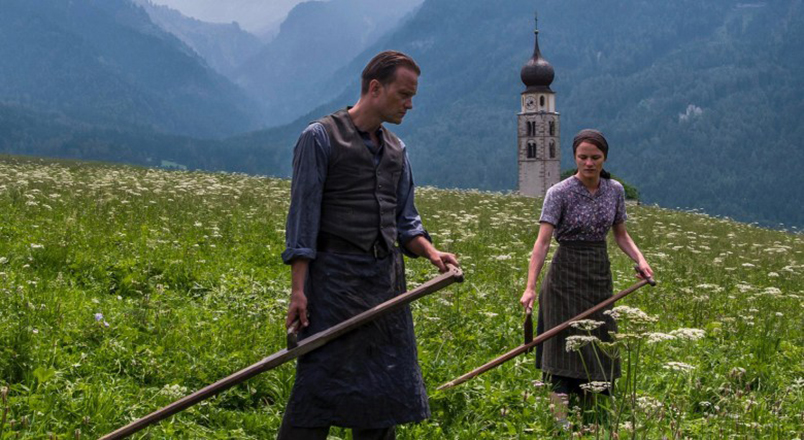
A Hidden Life is, if nothing else, a stunningly beautiful work of cinema; the film is marked by colourful images of the Austrian mountains and cloudy skies. One thinks of what Max Nelson says about Malick’s earlier film, To the Wonder:
One of the chief virtues of Malick’s sense of beauty is that it refuses to distinguish between a tiny gesture and a sunset, a waterfall, or a star-studded sky; one of its chief drawbacks is that this denies any small gesture the right to stay small. His eye is cosmic, and he can only consider the turn of a wrist or the tentative joining of two hands with the grandeur due an event of cosmic proportions. There is something oppressive about this all-inclusive view of beauty. It demands the full measure of our devotion and indeed our rapture, with little room left for the quieter, mellower ranges of aesthetic experience. Appreciate this! is the imperative couched within so many of Malick’s shots, recalling the command attributed to Christ at one point mid-film: “You shall love.”
This film’s sense of beauty commands not simply appreciation, but devotion, portraying a creation that is, in the words of Gerard Manley Hopkins, charged with the grandeur of God.
A common gloss on Malick is that he is preoccupied with portraying an Edenic image of Creation, constantly hearkening back to the glory, joy, and grace of living in a perfect garden. In A Hidden Life, however, Franz and Fani, as farmers, are more like Adam and Even cast out of Eden, working by the sweat of their brows, digging into the earth with their own hands and pulling plows with their own bodies instead of oxen. They are labourers in a fallen – albeit beautiful – world. And this brings us to sainthood.
Franz is deeply implicated in this fallen world, working as a farmer, living in a community that has let itself be overrun by Nazism, and worshipping as part of a Church Whose priests are milquetoast and fail to call their flock to heroic virtue. Franz is in this world but not of it. His conscience has been formed so as to know and reject the Nazi agenda as evil, even when the consciences of his neighbours have atrophied and celebrate that agenda. From this conscience, Franz has a mysterious call to heroic virtue and martyrdom that he can never fully articulate to anyone, including his loving wife, but which Malick allows us to glimpse and begin to understand as the only acceptable response that he can make to the evil which has sought him out.
Franz speaks with a painter working in the village church, who explains that although he paints images of Christ, he will not paint a true image of Christ until he has suffered. Franz undertakes that suffering, and so he is the saint who is the true image of Christ in imitating His Passion. He defies the ugliness of sin, and the limited vision of the Nazi propaganda video which opens the film in favour of the expansive vision of Creation. He is the effective apologia.
Operating in that fallen Creation, however, requires hope in God’s restoration of the world. That evil will always be with us, and so that heroic virtue that looks beyond the material world to God’s grace is necessary; this is the hope Fani expresses at the end of the film. In this way, the film is both an blisteringly excoriating attack on how the Church – both clergy and laity – fails when she accommodates evil and declines to express the truth clearly, and a recklessly hopeful meditation on the divine love which maintains the life of a saint and nurtures virtue, the mustard seed from which the Church grows.
A Hidden Life, while depicting the life of a Blessed, is not a hagiography; it technically ends on a note of ambiguity instead of adulation, depicting people who endure in hope in that divine love despite having difficulty seeing it amidst so much ugliness and sin and not yet seeing the glory of the Resurrection, but it is that hope that Catholics must foster to be saints. That hope is especially expressed in Franz praying Psalm 23 in voiceover, reiterating that the Lord shall guide him through the valley of the shadow of death. This voiceover is the culmination of years of voiceovers in Malick’s films, which are often parodied as being sophomoric Zen pablum when they are actually expressions of joy, sorrow, and questioning that are much closer to the Psalms, the prayers of the people of Israel recounting their history while in exile, like us living by the sweat of our brow. This is the prayer of Malick’s martyr, who waits for all things to be made new.
Finally, speaking of culminations, this film also functions as a response to Malick’s previous films, which I informally call his eros trilogy: To the Wonder, Knight of Cups, and Song to Song. Those films depict a modern world in which eros and sexual desire have been distorted by being disconnected from their sacramental meaning and the grace of God’s love, agape. In A Hidden Life, however, the marriage between Franz and Fani is an occasion of development in holiness, partly in the everyday work and sacrifice that makes up family life, but also in the prayers and love they provide to each other in times of profound suffering. Together, the eros and agape which permeate their marriage has made them fruitful, representing a promise to be faithful to each other unto death, but also faithful to God unto death. A Hidden Life, therefore, is not only the story of a saint, but of a married saint, whose marriage is the means of that sainthood.
 Malone has a Bachelor of Arts Honours in English from Campion College at the University of Regina, and a Juris Doctor from the University of Saskatchewan. He has written on literature, film, and culture for Catholic Stand and has also been published in Millennial Journal.