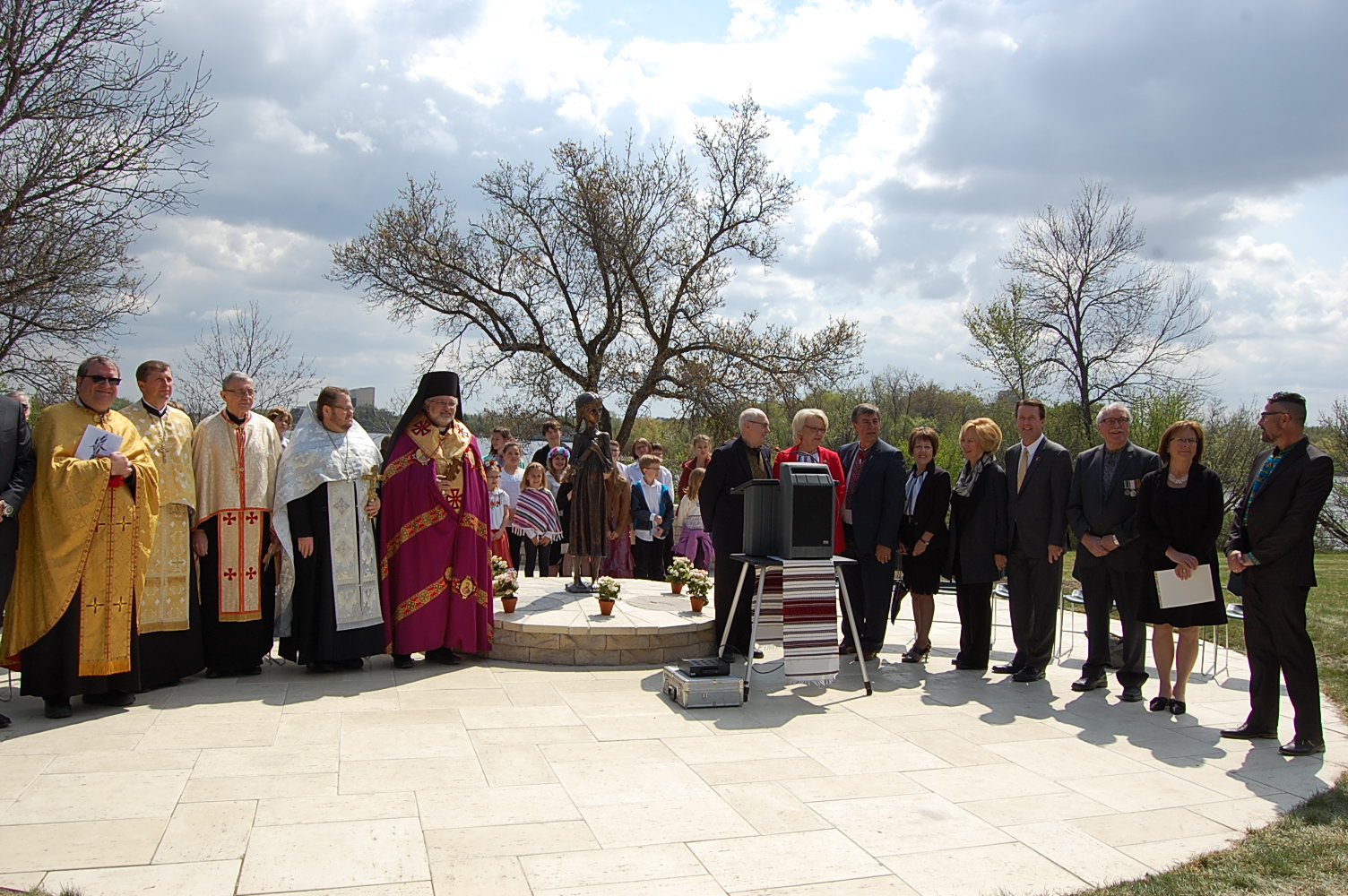
It’s obvious the girl, who appears to be about 12-years-old, is starving. She holds a few stocks of wheat in her hand. She is very thin. Her eyes are hollow. She is gaunt looking. She, is a statue, located a few meters east of the Saskatchewan Legislative Building on the shore of Wascana Lake in Wascana Centre Park. She is a memorial to the estimated seven to 10-million people who died in the deliberate starvation of Ukrainian people by then Soviet Dictator Josef Stalin in 1932-33; Holomodor, in the Ukrainian language. It is estimated that about a third of those who died were children.
The statue was blessed May 12, in an emotional ceremony by Saskatchewan Ukrainian clergy with a crowd of about 200 including representatives of federal, provincial and civic governments and representatives of the Regina, Saskatchewan and Canadian Ukrainian Congress in attendance. Several members of the crowd were descendents of Holomodor survivors and several wiped tears as the ceremony progressed. They were recognized by Ukrainian Canadian Congress Regina President Orest Gawdyda.
The statue is an exact duplicate, cast from the same mold, of that which stands in the National Holodomor Memorial in Kiev, Ukraine.
Saskatchewan Lieutenant Governor Vaughn Solomon Schofield, Saskatchewan Senator Raynell Andreychuk, Regina Mayor Michael Fougere, as well as officials of the Ukrainian Canadian Congress all brought greetings and spoke briefly about Holodomor and the impact it had on Ukraine. Keynote Speaker Saskatchewan Deputy Premier Ken Krawetz spoke of his own family’s experience and noted his family’s surname showed up often when he visited the Kiev Museum.
Today’s situation between Russia and Ukraine was voiced by National Ukrainian Canadian Congress President Paul Grod in his address. “Stalin was worried that Ukrainian nationalism would bring down his regime and Putin (current Russian President Vladimir Putin) fears the same thing,” Grod said. Grod also read a first person account of an individual who survived Holodomor describing in graphic detail the cruelty endured by people as they starved to death, blocked from trying to access food in neighboring countries after they were denied any access to food in Ukraine. Several areas of Ukraine were almost bereft of people and Stalin imported over 100,000 Russian speaking settlers to repopulate those areas.
Holodomor began in the early 1930s but reached its peak in 1932-33 when it is estimated that upwards of 25,000 people a day died of starvation or malnutrition related illnesses but it has only been in the 21st century that recognition has received wide acknowledgement. The Saskatchewan Government in 2008 passed a bill recognizing Holodomor as genocide, the first legislative jurisdiction in North America to do so.
The ceremony was opened and closed by the children in the Regina Roman Catholic School Division’s Ukrainian language program singing O Canada at the opening and the Ukrainian National Anthem at the end.