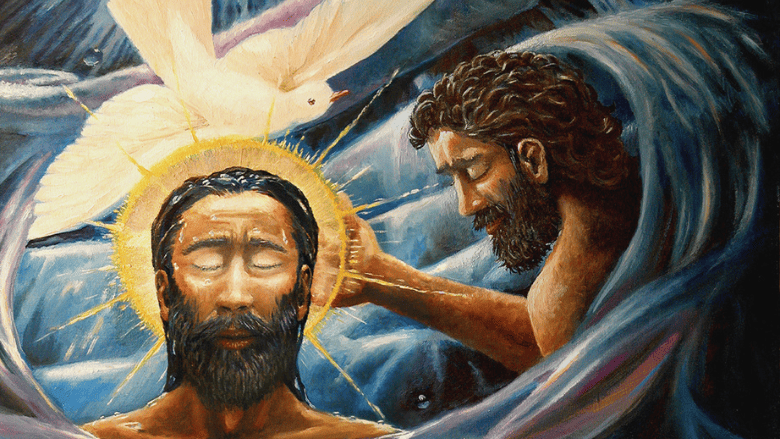
(Photo Credit – Wikicommons)
By Jane Korvemaker
On Monday, January 8th, the Church in her liturgy celebrated the feast of the Baptism of the Lord. This feast holds much rich insight to our own relationship with God.
All four Gospels testify to Jesus’ baptism in the Jordan. Though we might think it’s a little odd that the One without sin goes to John for a baptism of repentance, there are a few things that it signifies for us:
- Jesus humbled his divinity in order to fully identify himself in humanity, even though he is without sin;
- A voice declared from the heavens that Jesus is the beloved Son;
- The Spirit descended on Jesus (which does not inaugurate their relationship but furthers Jesus’ mission).
In particular, the descent of the Spirit strongly indicates to John (and eventually to the believing community) that Jesus is the Messiah and that the final times are here.
Wait – final times? Like the vision that the John the Apostle had, recorded in Revelation?
No, friend. That requires a particular interpretation. But with Jesus has come the Day of the Lord, the day foretold when God would put all things right in him; it is a phrase that also looks forward to when this work will be fully completed. We can also put it this way: Jesus is the fulfillment of all time (not a concept for the faint of heart!). We see this affirmed when a few verses later Mark tell us that he came to Galilee and proclaimed that the “time is fulfilled, and the Kingdom of God is at hand; repent, and believe in the gospel” (Mark 1:15).
Now, after his baptism Jesus is driven out into the wilderness by the Spirit. From this, we are meant to understand that all of Jesus’ actions are by inspiration of the holy Spirit. From the time that people became aware of him, and with 20/20 vision, it became understood that Jesus was completely receptive to the will of God; the Spirit’s descent is the evidence of this.
Right, but how does all this relate to our baptism?
I love this inquiry far more than the limits of an article can convey. Let me roll up my proverbial sleeves here…
Everything. It has everything to do with it. And our baptism encompasses even more than just its relation to Jesus’ own.
His baptism is like a microcosm of the Son of God’s work on earth, which culminates in the salvific event of his passion, death, and resurrection. When we are baptised, we are baptised into Jesus’ death so that we might rise with him in his resurrection (Romans 6:3-11). Our identity is defined by our baptism, a confirmation that we belong to the Lord.
It is due to Jesus’ salvific work that in our baptism, we receive the same Spirit that descended on him. The same Spirit who guided and directed Jesus to live according to God’s will now dwells within us so that we can have the same disposition that Jesus had toward God’s will.
In fact, we only need look to Mary, who is the first creature who had the grace of this gift, to see its effect! This is why she is venerated first among all saints and why she is archetype of the Church. In our baptism, we are changed in our very humanity to be able to be as receptive to the Spirit – who mediates God’s will – in our lives as Mary was in her life.
This means that we have a Spirit-driven mission! Our task is to discover the gifts the Spirit brings with him, dwelling within us, that evoke our desire to do God’s work.* Whether we be young or old, God gifts us with everything we need to obey his will here on earth: that of loving and serving him by loving and serving others. There are many and varied ways in which we can actively respond to our mission based on our unique personalities and gifts.
Our baptism is the gateway to human fulfillment; by God’s inestimable grace, we can find our happiness in obedience to him. Our mission is to receive God’s own love as fully as we are able and become his love – become Christ – to others. In this way, we offer ourselves back to God in a great union and movement, that of eucharisteo – thanksgiving.
*One method that has recently been gaining momentum for discernment is the Catherine of Siena Institute’s Called and Gifted gift-discernment process. Our Lady of Lourdes in Saskatoon is offering this process starting in February if you’re interested in joining.

Jane Korvemaker is a B.C. transplant who lives in Saskatoon with her husband, three children, and mischievous cat. She holds a Certificate in Culinary Arts, Bachelor of Theology, Certificate in Youth Ministry Studies, and is a Level Two Catechist in Catechesis of the Good Shepherd. She hopes to one day find the perfect pairing of bacon, beer, and Balthasar. She semi-regularly writes at ajk2.ca