By Peter Oliver, Catholic Health Association of Saskatchewan
National Catholic Health Care Week (NCHCW) is celebrated on February 1-7, 2026. Its theme, “Open Hearts, Healing, Hope”, affords an opportunity to reflect on Catholic Health Care’s sacred foundation. That’s an enriching opportunity that can be supported with a little help from a cinematic drama.
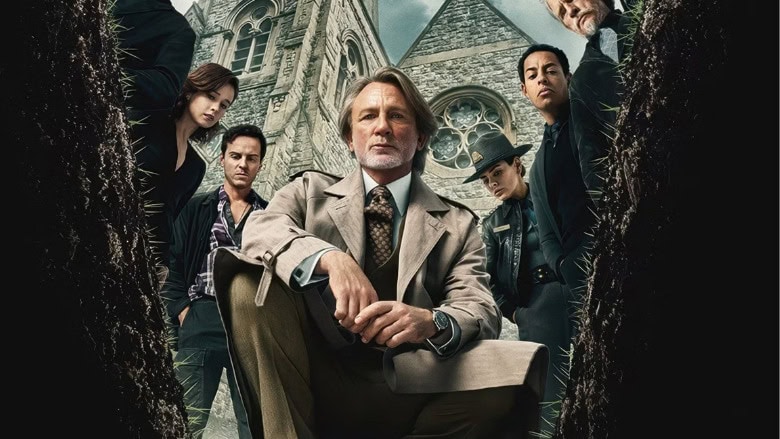
The recent film Wake Up Dead Man: A Knives Out Mystery, with its sweet, albeit eccentric, detective Benoit Blanc, provides an unexpected entry into a deeper appreciation of Christ’s healing ministry.
Spoiler alert and sensitivity warning: watch it before reading further, but know that it contains some “college” humour. That said, the film is remarkably Catholic.
While no longer a Christian, its director, Rian Johnson, speaks of approaching the religious aspect of the film with a generous spirit. He also did his homework, including significant conversations with several Catholic priests and rereading all of G. K. Chesterton’s Father Brown stories (America, Jesuit Review, Dec. 18, 2025). The result, Wake Up Dead Man, masterfully explores what constitutes an open heart, and it can help us probe the theological core of NCHCW’s theme “Open Hearts, Healing, Hope”.
The film is constructed at the intersection of five corners: Fr. Jud Duplenticy’s search for vocational authenticity in a world of twisted moral certitude; the modernist and rationalist detective Blanc’s encounter with “truth” in the person of Fr. Jud; the deterioration of the parish of Our Lady of Perpetual Fortitude under the tutelage of the incendiary preaching and shaming of Monsignor Jefferson Wicks; the role of the primary antagonist Martha Delacroix and her connection to the whereabouts of a diamond dubbed “Eve’s Apple”; and, finally, the operative mystery – who murdered Wicks?
That level of complexity makes for a great whodunit, but with Chestertonian dexterity, Johnson unfolds a deeper mystery, namely, how love overcomes sin and evil.
This brings us to the “Louise moment”. Evidence that Fr. Jud is the murderer is mounting, and the mood is URGENT. Seeking a critical piece of information that could prove his innocence – who ordered some construction equipment – Fr. Jud calls Louise at Steel Wheel Construction. But Louise is a bit of a meandering gatekeeper:
JUD: Yes, and what I need to know is
LOUISE: I run this place with my brother James; he takes the orders, but I process the orders
JUD: Right, and the reason I’m calling
LOUISE: And I’ve been to that church of yours, but I don’t think you were there
JUD: No, I’m new, relatively new here. Louise I’m
LOUISE: Oh, congratulations. It was Father what’s-it, Older guy, Wicks?
JUD: Monsignor.
LOUISE: Ok, it was Father Monsignor preaching when I went and let me tell you, that is not a nice man, but I am sorry that he died, I’m sorry for all y’all’s loss over there (Document Cloud, ScreenPlay, Wake Up Dead Man).
The dialogue continues, and after what seems like an eternity, the call nears its end. Louise doesn’t have the information, but her brother James does. She will have him call back. Then comes the question that changes Wake Up Dead Man from a fun whodunit to a film with a beautiful soul: “Fr. could I ask you something?” followed by a long silence, “Fr. could you pray for me? (ibid)”
Fr. Jud STOPS and recognizes he has a sacred duty, and as a result, we learn Louise’s mother is in a hospice with a brain tumour. They’ve had a fight and are no longer talking.
The script is moving: “…the tumour in her brain, it’s affected her and made her say some terrible things. And I said bad things back. And now that might be the last thing we said to each other. And my brother is angry. He’s right, and I hate myself. I feel so alone (ibid).”
When Fr. Jud shifts his attention from self-preservation, Louise becomes a person, not just some stranger with a solution to his problem. He steps into another room to listen to her, and at the end of the call, he assures her of his compassion and his willingness to be there for her: “Ok, Louise. You have my number, any time, day or night, I’m here for you. This church is here for you. Bless you (ibid).”
The “Louise moment” is a Catholic Health Care moment par excellence! Relationships are the central issue: Relationship with God: “Fr. could you pray for me?” Relationship with others: Louise’s relationship with her mother, who is dying, and the friction she is experiencing with her brother. Relationship with self: Her mother’s internal struggle with distorted thinking as she is dying, and Louise’s feelings of hopelessness, “I hate myself. I feel so alone.” Fr. Jud’s patient response acknowledges the significance of these relationships, and the conclusion of the film reveals the impact of his decision.
In whodunits, the honor of unraveling the crime falls to the detective, but in the closing act of Wake Up Dead Man, Detective Blanc chooses to forgo the limelight so that a higher purpose may be served – Martha’s confession to Fr. Jud. Blanc’s humble decision is inspired by Fr. Jud’s attentiveness to Louise, and because of it, we discover that it is only “in forgiving Grace” (double meaning intended) that Martha can let go of her attachment to Eve’s Apple.
Finally, in the closing scene of the film, we discover that Fr. Jud has hidden the jewel in the breast of the corpus of a cross he made for the sanctuary of the parish, now renamed Our Lady of Perpetual Grace. It’s a fine conclusion to a cinematic parable that helps us recognize that the source of Fr. Jud’s action is found in Christ’s Sacred Heart.
That, too, is the sacred foundation of Catholic Health Care’s open heart and the origin of the healing and hope it offers.